An Alpine Binding Primer-
Which bindings are right for me?
I'm going to start by saying what this post DOESN'T talk about....
Firstly, It's not about how to set or adjust your bindings.
It's, also, not about how to install them - I addressed that in my "How do I Mount My Own Bindings" post.
It's not about one binding being better than another, and it's not a deep dive into functionality (although, who knows...? I could run off on some tangent while writing this. I tend to let myself ramble a bit).
What it IS about is giving a broad description of some basic functionality to help you decide which ones may be right for you.
Lets start with a few basic definitions:
TOE or TOE PIECE: Is the part of the binding which interfaces with toe lug on the front (at the toe box) of ski boots.
HEEL or HEEL PIECE: Is the part of the binding that interfaces with the heel lug (at or below the heel cup) on the rear of a ski boot.
AFD or Anti-Friction Device: A section of the toe piece that is aligned with the section of the ski boot sole (sometimes also referred to as an AFD) that is designed to be hard and smooth such that the sole sits on it and slides consistently left and right. The AFD can be static where the boot sole sits on an ultra-smooth surface (such as teflon) or active where a section of stainless steel, which sits on a track which allows the AFD to glide left and right and is then recentered by a spring or springs).
Toe Height: All bindings must adapt to subtle differences in the height of the toe lug from the base of the boot's AFD, as there is an acceptable range of positioning for said toe lug (also to accomodate for wear at the toe).
NOTE- Heel height used to be adjustable in some older binding systems (most notably some Tyrolia heel pieces) but, for the most part, this adjustment has been eliminated from binding set up. Heel height is now accomodated for by binding design improvements.
Toe Width: Some bindings feature manual adjustments, meant to improve binding performance by tightening the tolerances between boot and binding toe, such that minor differences in boot width can be accomodated for. Most binding manufacturers have eliminated this adjustment. This adjustment required adjustment often, and was, largely, unreliable. Many skiers swear by these toe pieces, but such preferences are now based, mostly, upon fallacy than fact. Binding performance is more a factor of where the binding comes in contact with the boots, and how strong the springs are in the bindings.
Heel Cup: The section of the heel piece which is formed to accomodate the boot heel.
Springs: There are springs for toe release (toe spring or toe tension spring), heel release (heel spring or heel release spring), and forward pressure (also in the heel piece and often referred to as the forward pressure spring) which effect how much pressure is required for a boot to release from a binding.
Forward Pressure: When a ski flexes, the distance between the toe and heel pieces gets shorter. When it anti-flexes (rebounds), the distance gets longer. To accomodate for these situations, binding heels are built on a track (or other system which can accomodate fore/aft movement) which allows for some fore/aft movement as the ski flexes. Forward pressure is most commonly addressed in the heel because toe postion on a ski is more important for ski performance than heel position, per se.
Release Setting: (otherwise known as DIN [not DIM] setting or "Z value"):
A binding's release setting applies to the amount of force (defined as Nm or newton meters) needed for the boot to release from (come out of) the bindings. A Newton meter (Nm) is the standard international (SI) unit for measuring torque (rotational force) and energy.
Release setting is determined by a skiers height, wieght, age, boot sole length, and self- evaluated aggressiveness.
System Binding: sometimes referred to as track bindings, or plate bindings, This is more of a synergistic system than just a binding. The bindings screw into, or slide on a track, which is (usually) premounted on the skis. These bindings dont require drilliing into the ski to install them, and can accomodate a big range of boot sizes. These binding systems can also effect performance of the skis, and are often installed to apply specific characteristics to ski performance. System bindings are quite handy on kids skis, as it can allow changes in boot sizes without having to re-drill a ski every time boot sizes change. System bindings can be heavier than traditional flat mount bindings.
Binding Plates: These are meant to enhance ski performance (usually through stiffening the skis). They are usually found on high performance or race skis. Binding plates also add weight to skis.
Binding Jig (or binding template): A device which makes binding/binding plate installation quicker, easier, and more accurate.
Return to Center (RTC): This is often referred to in association with speed of return and/or elastic travel. In the act of skiing, releaseable bindings have some range of motion while the boot is interfacing with the bindings. Springs don't hold bindings static as the shocks of gliding over terrain reverberate through the ski. Some play is natural to a bindings function, and said play acts to avoid shock. However, to avoid pre-release while absorbing shock, ski bindings must return to the postion where the boots are centered in the bindings, or the skis will not glide properly and the boots will inadvertantly release from the bindings.
Elastic Travel: This is the range of motion a binding has before it reaches a point of no return and releases the boots. You can see the elastic travel of a Look Pivot Toe Piece in the .gif that represents this post.
Pre-release: This is undesireable, early release of a ski boot from a binding while in the act of skiing. It is often associated with injury and reflects poor performance, wear and tear of the boots and/or bindings, improper maintenance and/or adjustment, and falling while skiing.
Inspection Value: The release setting which is determined AFTER testing.
Bnding test(ing): All bindings are required to be inspected and tested, on a regular basis (determined by the manufacturer and/or legal governing bodies), for effective and efficient interface with ski boots and consistent retention and release. Testing must be done with approved devices and by certified technicians.
Certification: Binding technicians must prove a minimum level of proficiency via testing and (sometimes) apprenticeships. In doing so the vendor may certify them and apply indemnification to that shop and any individuals certified to work on their bindings.
Shops may also be certified to sell and maintain a vendor's products. In doing so indemnification and warranty may be applied to that shop.
Binding Indemnification: As a legal term, INDEMNIFICATION means compensating someone for losses or damages they've occured. In the context of ski bindings, it commonly (although, often not accurately) refers to the manufacturer and maintainer's liability for the skier's injury or damages. Ski binding manufacturers maintain a list (most commonly updated annually) which informs binding technicians which bindings are still covered for liability. Bindings can be removed form the list due to age, technological changes, environmental factors, changes in standards, audits of reliability, recalls, and/or several other reasons over their lifecycle. Removal from the list informs technicians that they should not work on these bindings, and/or there's a problem (or problems) with them which affects safety and performance.
Binding Compatibility: There are several standards, as determined by the ISO (International Organization for Standardrization) which dictate whether or not a boot and binding combination perform properly (and/or effectively) together. Several factors can apply to compatibility, with the most common factors being changes in standards (GripWalk vs non-GripWalk boots and bindings, Touring boots and bindings vs alpine systems, and child vs adult systems). Also, wear and tear on the skis, boots and/or bindings can also effect compatibility.
Along with these most common definitions, there's a lot of technical jargon which, generally, isn't of use to the average consumer. For that reason, and reasons of liability, I wont get into those at this time.
With those out of the way, I'll get into it now.
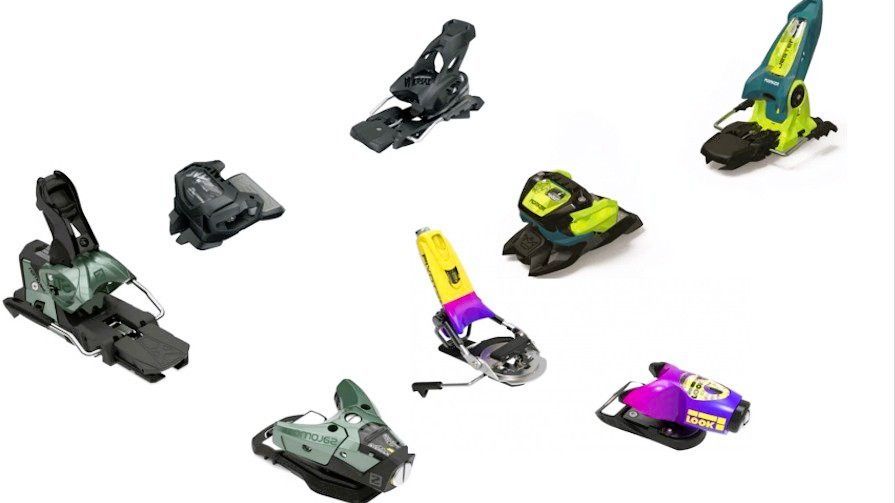
As of this writing, there are four major binding manufacturers. There are some smaller companies who either make "boutique" brands (Knee bindings, etc) or accoutrements to existing bindings (CAST, etc), but, for the most part, there are 4 major players.
They are:
- Marker
- Salomon
- LOOK
- Tyrolia
Those manufacturers also make bindings with partner brand labels.
Salomon bindings are under the AMER SPORTS umbrella. Salomon is the primary brand, and they make binding models under the partner brand labels of Armada and Atomic.
Tyrolia Bndings are under the HEAD Sports umbrella, and they make bindings for Elan, Fischer, Kastle, etc.
Marker falls under the Elevate Outdoor Collective. While they used to make bindings with sister brand labels, all bindings made by them now fall under the Marker name. That said, binding systems found on Volkl, K2, Blizzard, Nordica, Line, and a few other companies, are commonly made by Marker
LOOK makes bindings for Rossignol and Dynastar, since those companies are all under the Rossignol umbrella.
Each of those brands makes both flat mount (each pair of skis is drilled specifically to fit those bindings at a specific boot size) and system bindings (tracks come pre-installed on partner brand skis and the bindings themselves are installed by sliding them onto that track)- This method allows for adjustability without having to re-drill the skis to accomodate boot changes which fall more than a size different from the boots which were previously installed.
Flat mount bindings are installed using a template (or JIG for us old schoolers).
Templates vary by brand, bindings type, and sometimes by model. Although, most modern templates have the presets to install multiple models.
Firstly, the ski is held in a special vice. The template is then clamped onto the top of each individual ski, with the ski tip to the left, and the tail to the right.
The length of the template is adjusted to allow the boot to fit firmly between the toe and heel stops (in the case of any examples used in this post. all templates are set to the same 27.5 ski boot).
Boot center is verified to align to the jig center, then that is aligned with ski center.
The ski is then drilled with a special drill bit that sets the correct depth of the holes to correspond with screw length. The diameter of the bit is determined by the ski manufacturer. The holes are drilled using specific guides (pilot holes in the jig) for the binding model used.
The holes are then cleaned out, special glue is added, then the bindings are attached by screws which are torqued to manufacturers specifications. The bindings are then adjusted to the manufacturer's specifications.
BINDING TEMPLATES: (For Tyrolia, Look, And Marker Bindings):
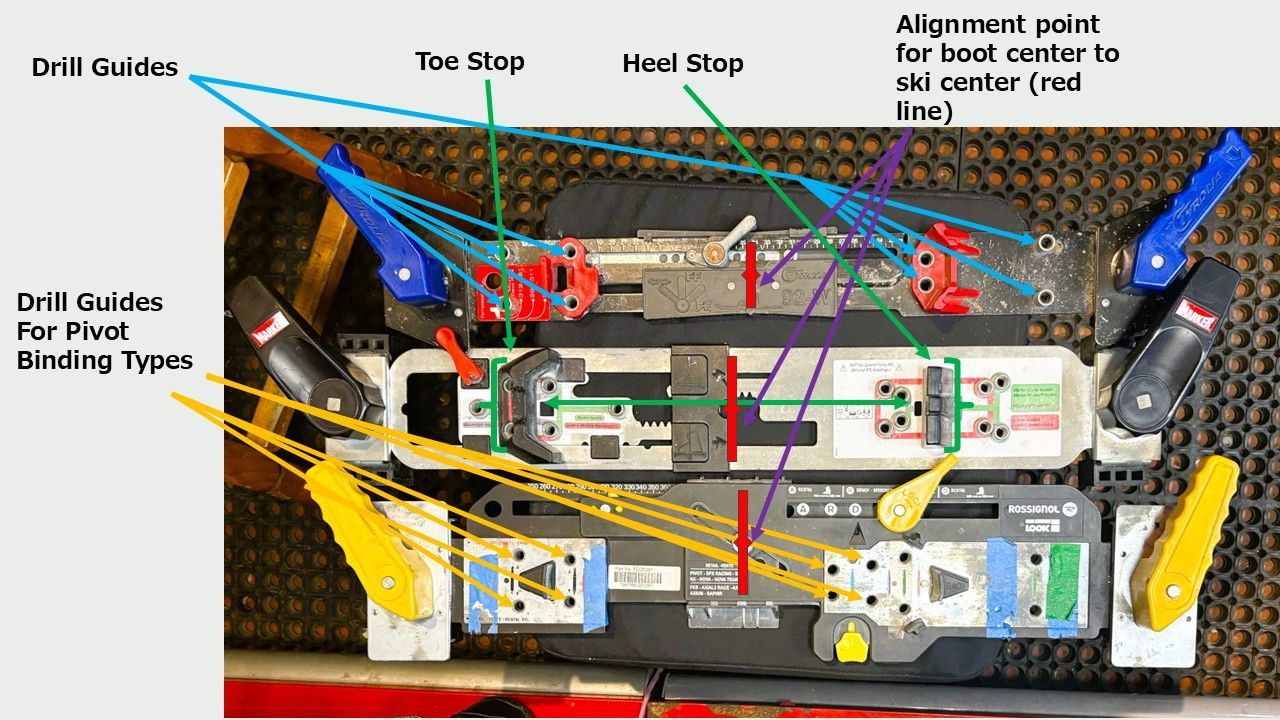
Let's look at the mountng zone (where the bindings actually sit on the skis).
Observing the LOOK Binding template, this device is designed to accomodate multiple binding models. The yellow arrows point to the specific drill guides for the PIVOT models.
In the following graphic , the shapes of the binding toe and heel mounting plates are overlaid using colored shading.
Note the shorter mounting zone and tighter drill hole patterns for both the heel and the toe with the pivot.
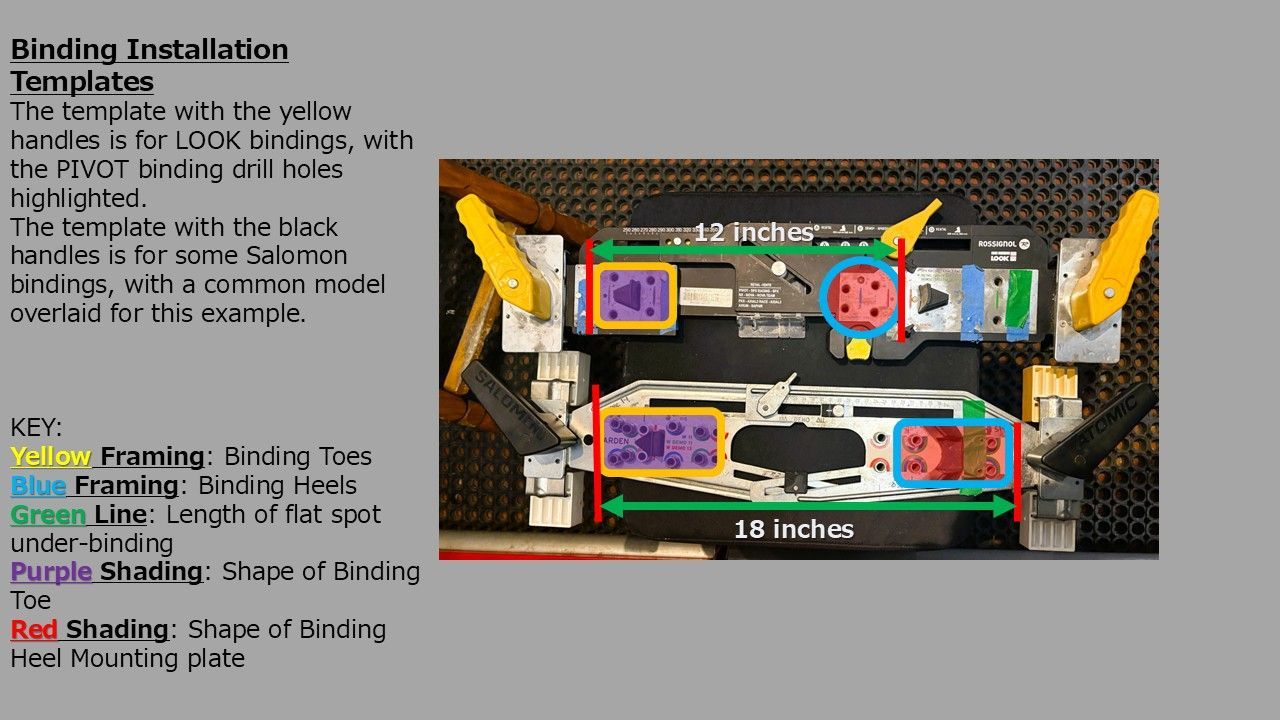
The shorter mounting zone reduces the flat spot created by the interface between the boot and binding. Additionally, the smaller footprint of the binding toe and heel pieces reduces those flat spots as well. This allows the ski to flex more naturally, which changes the feel of the skis, somewhat.
This situation is preferred by users on skis where a rounder flex is advantageous; park skis, freeride skis, certain softer model skis, etc. This shorter mounting zone AND the tighter hole pattern of the pivot heel reduces binding pull-out and ski breakage caused by a situation where the tail is subject to extreme flex (tail butters, landing a jump on the ski tails, getting thrown back in a mogul course, etc.).
Freeride skiers and park skiers, commonly, jump on and off features, do acrobatics in the air, attempt jumps from great heights and at great speed, etc., so they prefer a binding that's a little more forgiving. Therefore, there will be some boot rock laterally. Additionally, power is sacrificed to the front of the skis because there is some heel lift which is a result of this design.
Park skiers and freeride skiers tend to "ride" their skis, opposed to really driving their edges (drive their skis), so this "play" is irrelevant to them, as they don't demand the kind of precise edge grip a carving skier or racer requires.
-Think about it like this; Park and Freeride skiers aproach skiing more like someone pointing a toboggan at jumps than using their edges for speed control. They tend to aim their skis at a target (feature or otherwise) and use controlled skids to scrub off speed or to make quick direction changes.
LATERAL PLAY IN A FREERIDE BINDING:
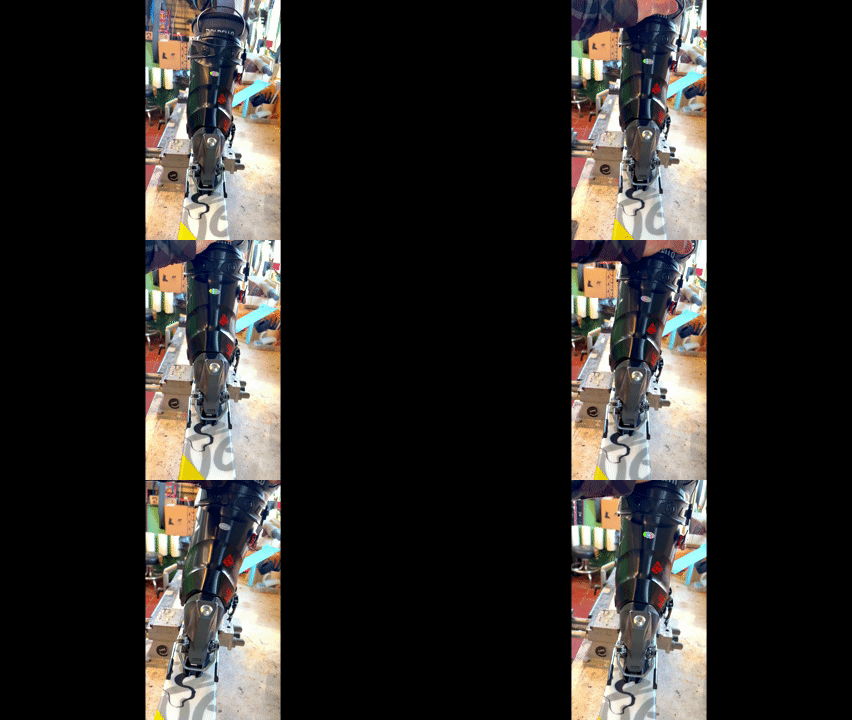
The manufacturer for the pivot also claims it has the most elastic travel (the ability of the binding to react to the boot moving away from center and recentering without releasing). Freeride and park skiers prefer that their skis stay on in most situations, so that also makes these bindings desireable for those disciplines.
Additionally, the bindings have a rotating heel. The original claim by the manufacturer was that this turntable design reduced rotational fractures of the Tib/Fib. I have not seen any modern testing to support this claim, and the manufacturer no longer lists that claim on it's sites.
The heel piece will rotate on its mounting plate 360 degrees. Here's a demonstration of how it works with the boot in the binding.
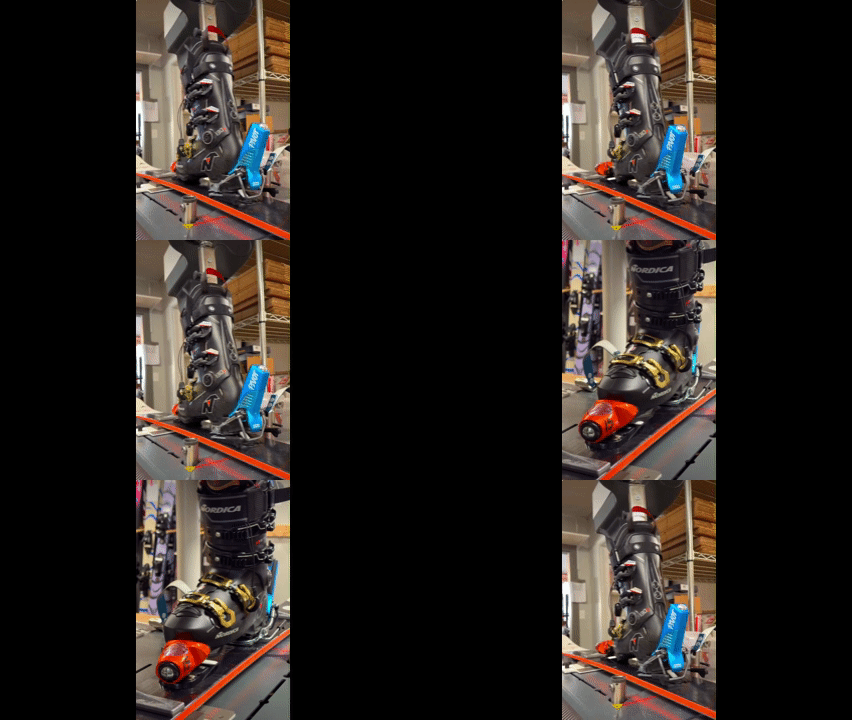
As you can see, the heel piece twists with the boot as it rotates through its release cycle with the toe.
NON-Pivot bindings:
Bindings with more traditional funcionality are for skiers who have the opposite concerns; These skiers want to ensure more power is tramsmitted directly to the skis to facilitate control.
Some focus on the toe; they make the toe piece a bit wider, for a more precise hold of the toe.
Salomon claims that the AFD (Anti-Friction Device- this is the platform the flat spot at the base of the boot toe rests upon) for their STRIVE models are the widest in production (+-70mm). Wider contact with the boot applies more leverage to the skis laterally.
Marker and Tyrolia use a similar concept, with the contact points for the toe piece to binding at the widest points on the toe lugs.
Many have adjustable toe-height, which is a firmer interface than self-adjusting bindings.
Self adjusting toe-pieces allow for some vertical elasticity so the toe does not require manual adjustment. However, that allows for a bit more lateral boot rock in the bindings.
Others focus on the heel-
Single pivot heel pieces with a high vertical angle reduce boot rock and lock the heel onto the skis more firmly. Bindings like the Look SPX, Marker Griffon and Jester, Tyrolia Attack 11 all have this feature.
The Tyrolia Attack series and Salomon Strive series have a multi-cam entry and release system in the heel. This allows for a shorter "throw" of the heel release mechanism. This makes getting in and out of the bindings easier (it requires a bit less force to step into the bindings). This translates to stepping into the bindings after a fall on a steeper slope, easier.
Most bindings are purpose-built- Case in point, versions of the Tyrolia Attack 14 have a manual toe height adjustment and wide AFD for control, but the heel piece has a shorter throw on the release actuator, which makes geting out much easier, and entry on the hill easier as well.
The Marker Griffon has a wider contact point at the toe, and a steep angle to the heel piece which allows for less boot rock in the binding.
The Marker royal family bindings (Squire, Griffon and jester have reduced their stack height (the bindings allow for the boots to sit lower to the ground) which increases the speed of edge to edge roll-over.
Racers on speed skis prefer more height off the ground because that applies more leverage to the skis (a longer lever gives more power), but slalom skiers want their skis to be very quick edge-to edge, so they may not want as much hight off the snow.
Others focus on convenience; The Look NX series, Strive 12 most system bindings, alomg with Marker Squires, have auto-toe height adjustability and easy step in heels.
After 2026 all Marker Griffon bindings will also feature auto toe height adjusting.
Some claim to add additional safety features (Knee binding, Tyrolia Protector bindings, etc.). These bindings feature a third release tension setting which allows the heel to release laterally, or in such a way that can reduce lateral forces during the release cycle. The claim is that these bingings reduce ligament injuries in the knee and some rotational fractures. There have been many studies regarding this functionality. A simple Google search will bring up a list for you.
An industry proponent for this system is Rick Howell. Mr Howell relies upon some of the technology tied to the Knee and (now defunct) Geze binding system. You can find some of the data from the aforementioned studies on his webpage at his retail page HERE.
Rick is also more than happy to discuss bindings, ad nauseum, as he is world politics. Be advised, he can be quite opinionated, and his aggessive approach to discussing binding technology (and politics) has made him a bit of a pariah in the industry.
DISCLAIMER: I would recommend reviewing all available data and weighing the cost benefit of any binding purchase before taking anyone's word, verbatim.
In the end, most people can't feel the difference with their bindings, but the differences are very real, and can make a big difference in terms of performance.
I'll describe the above features, along with system bindings, in the function summary at the end of this post.
System bindings vs flat mount
System bindings:
System bindings can slide onto a single track which holds both the toe and heels, or separate tracks for the toe and the heel. Separate toe and heel tracks tend to restrict the skis flex a little less, and are employed on skis that require better flexibility (especially underfoot).
Track and binding combinations tend to be a little heavier than flat mounts. That, of course, depends upon the models. For example; The Rossignol-Dynastar/Look Konect system is for higher end skis, therefore the bindings are, usually, of a higher quality.
Race quality bindings are generally heavier overall (especially systems), but that level skier is less concerned about weight underfoot, than they are with the overall swingweight of the skis. In fact, some prefer heavier binding and ski combinations (for various reasons).
Rossi/Dynastar also makes race plates, which improves the performance of skis (skis are often manufactured to accomodate these plates, therefore creating a synergistic improvement of performance). These plates (the current version is R22- and the junior R21) have predetermined positions for the bindings, matched to a range of boot sizes. Again, the bindings are generally heavier, because the springs are stronger, and the casings to hold them are more durable.
LOOK also makes the XPRESS System, which is lighter, and employs a more general purpose binding that emphasizes light weght, and ease of use and setup.
Marker, also, makes a couple different types of plates. Marker's race plates have pre-determined mount points, for both their world cup aluminum plate and their piston plate.
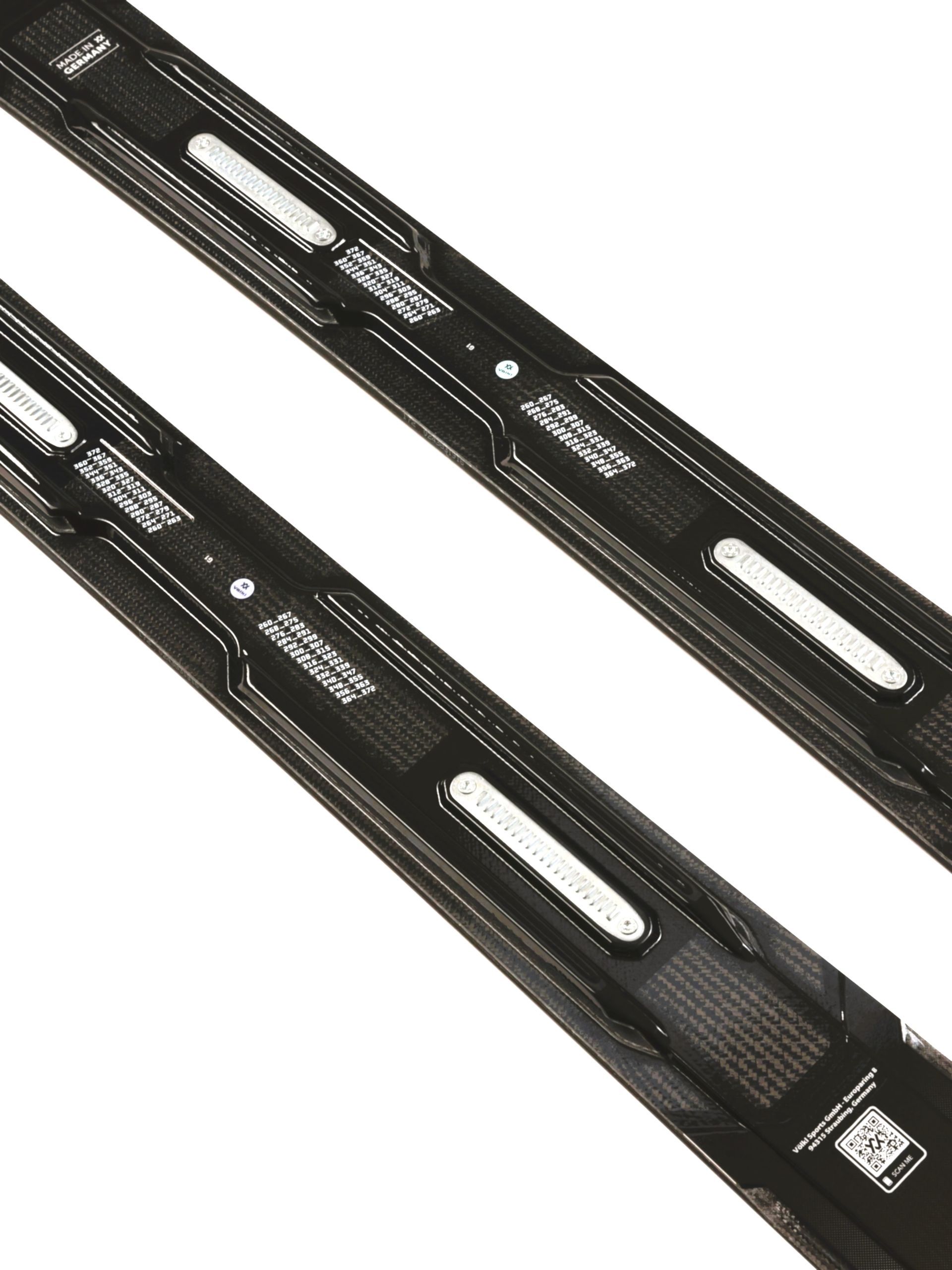
They employ two different rypes of systems; a basic plastic plate in which the bindings slide on with a full range of boot size adjustability (R-Motion for high end carving skis and V-Motion for a lighter system), and Lowride (Lowride TCX), which doesn't employ a plastic plate; the (track) for the Lowride bindings are integrated into the construction of the skis. In other words, there isn't a plastic plate installed on top of the skis, the "track" is part of the physical mold of the skis- There's a raised area molded into the skis, with very tight tolerances to boost ski performance.
LOWRIDE BINDING SYSTEM:
Atomic/Salomon Race plate system:

Atomic/Salomon Race plate system binding:
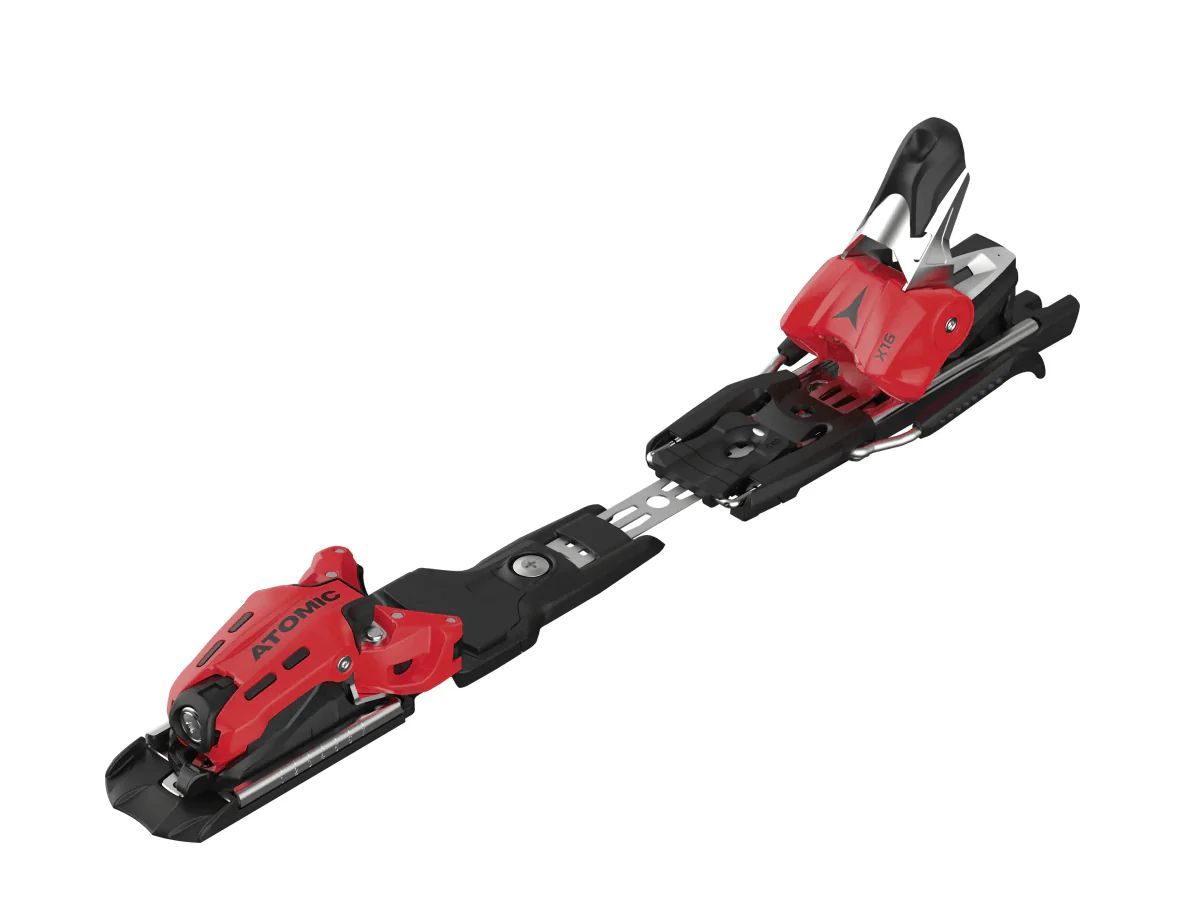
Salomon/Atomic is similar to Tyrolia/Head where they use plastic tracks, both where you slide the individual pieces into the tracks or, with race systems, then assemble a toe and heel piece with a metal bar which is attached onto a track plate. This is one of the more complicated systems for binding techs to install and maintain. The interface is precise and requires significant "tweaking" to set it up correctly.
Tyrolia does a similar plastic plate system, and race plate system. Tyrolia's race plate also involves assembling the toe and heel with a metal connecting bar, then sliding the entire assembly into the track.
Some manufacturers also make a separate, and very solid (and heavy) race plate, where some require drilling like a flat binding, or are pre-drilled to accomodate bindings from the same manufacturer (I'll include examples at the end).
FLAT MOUNT (open skis):
Flat mount bindings are, quite simply, bindings which are installed by drilling into flat skis (skis without plates or binding tracks) and screwing them on semi-permanently.
This is a more precise method of binding installation and (usually) requires a jig and several tools/glue to install them (along with significant expertise/training/certification).
In these situations the specific boots being used (both of the pair) are required (although, some may argue otherwise). Once installed, there's some adjustability to accomodate a different boot, but that's usually within one size larger or one size smaller. Any boot changes of more than 1 size difference will require a remount, where the old holes are filled and new ones drilled to accomodate the binding placement for the difference in boot size.
To sum it up, flat mount bindings are, generally more precise in terms of boot position on the skis, and sit lower than most system bindings.
Allow me to digress a bit here to discuss binding height-
BINDING HEIGHT-
The higher a binding is off the skis, the higher the boot sits off the snow surface. The advantage is leverage (especially on firm snow); the added height allows more power be applied to the skis (remember your basic physics; a longer lever means MORE leverage- vis-a-vis, more power to the skis). The amount of power reduces a bit as skis get wider, because the force is less directly translated to the skis edge. The closer this edge is to the centerline of the lower leg and skis, the more power that is applied directly to the edge. So, with wider skis, things get a bit more complicated.
The disadvantage of more height, is that the higher the boots are off a firm snow surface, the greater the distance the knee has to travel to roll from upright to edging. That means the skis roll over slower (remember the formula for speed=distance/time).
Some may argue that this isn't a concern on soft snow-
What really happens is the dynamics of the ski's performance changes a bit in soft snow, but the length of the lever (the distance from the bottom of the skis to the knee) doesn't change.
There is, however, a change as to where the ski pivots left and right- the the pivot point of the skis remains down the centerline of the lower leg (and the skis) on soft snow.. On firm snow, the pivot point is the ski edge. With wider skis, such as a 115mm width, that converts to 4.53 inches (roughly, 2.25 inches to each edge). That may not sound like a lot, but your knees and hips will let you know that it after a day or too of skiing on hardpack.
So, dynamically, ski performance is effected by the knee being further away from the snow surface/base of the skis by how long it takes to roll the skis from edge to edge, no matter the width of the skis. As skis get wider, this will negatively affect edge grip on firm snow. Which, is why, racers/carvers/hard pack skiers prefer narrower waisted skis.
Long story short, with flat mount bindings, the knees are closer to the snow (all things being equal), which makes the skis quicker edge to edge (quicker is also considered to be easier; as in easier to "edge" and easier to turn).
See the graphics below to illustrate the difference between bindings installed directly to the skis and bindings installed on a lifter/track/plate (all other things being equal):
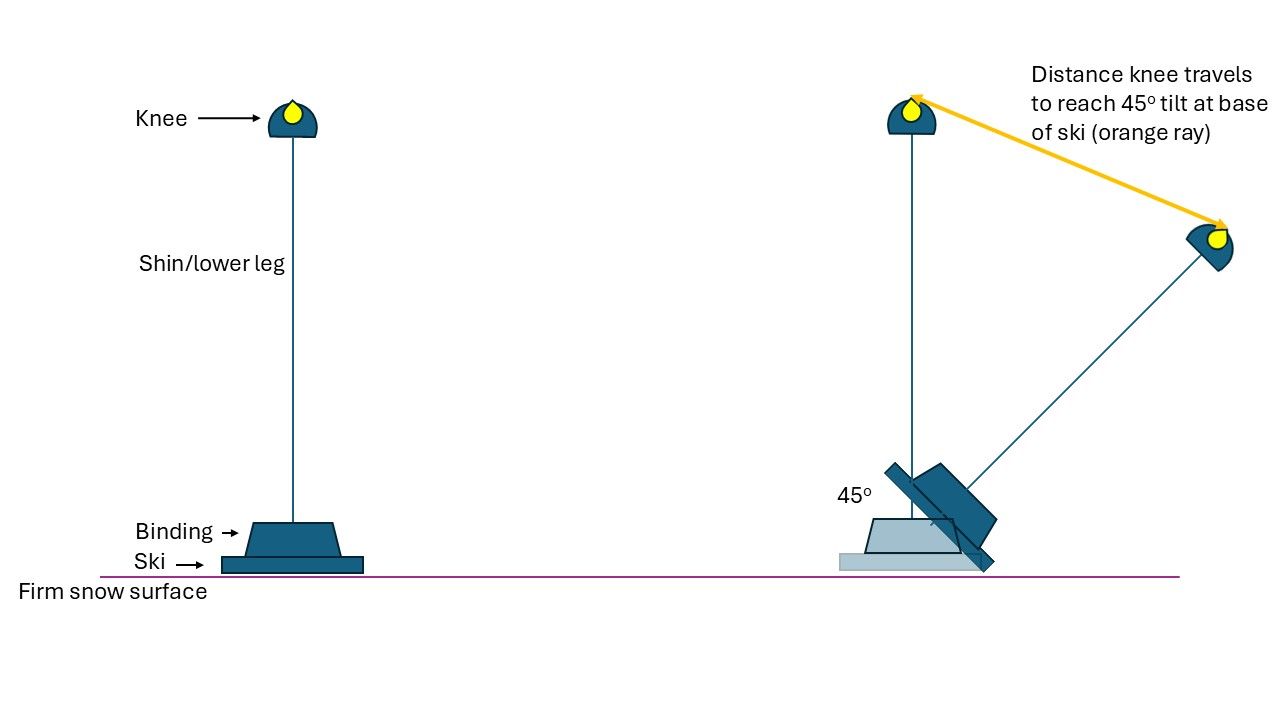
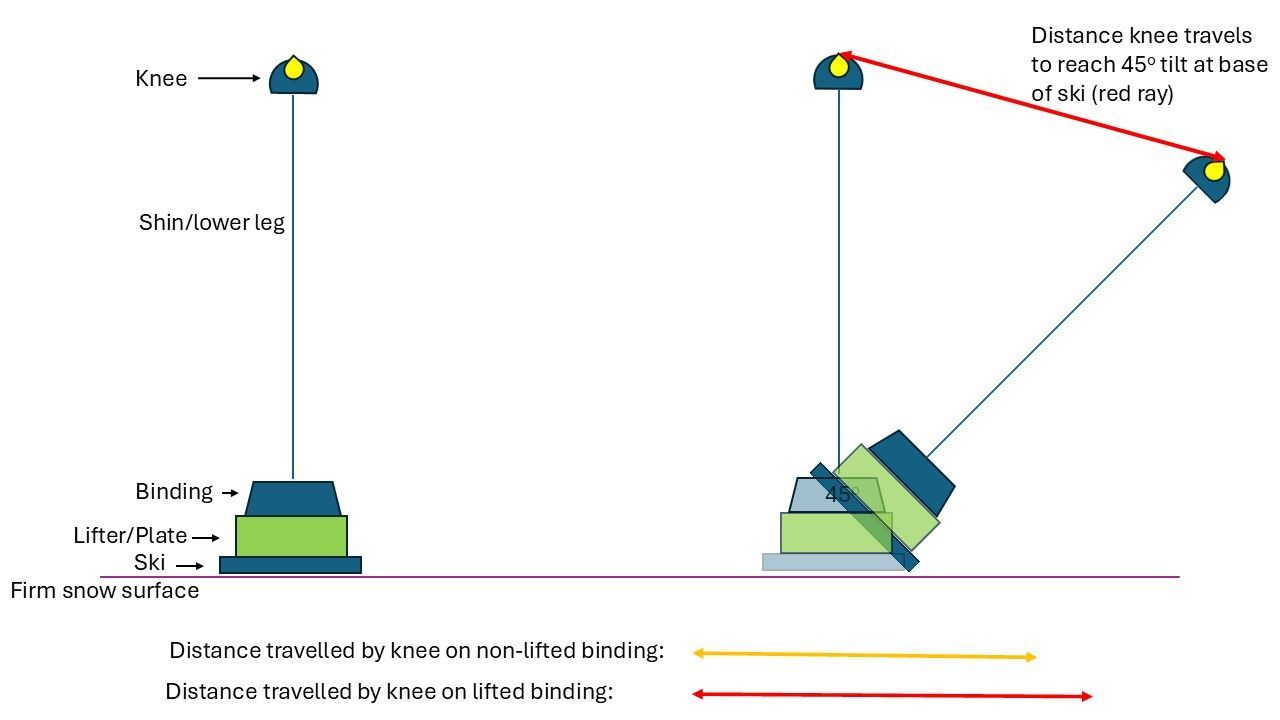
Note from the above, that the red line (as indicated from the graphic reflecting the higher binding system) is longer than the orange one (as indicated from the graphic reflecting the lower binding system). So, in the simplest terms, it takes longer to roll the skis edge to edge as the knee travels further from the centerline to reach the same amount of edge angle.
Ok-
Lets get into some specifics.
Release settings, brake widths, and adjustability-
Release Settings:
Many Binding models have the highest release setting listed in the name; "Attack 14", "Squire 11", "Pivot 15", etc. As a general rule, heavier, stronger, more aggessive skiers require higher release settings. The highest release gives an indication of how strong the spring is.
In a perfect world, a skier's release setting should fall close to the middle of the range listed in the setting window. So, if the relase setting range goes from 5-11, the optimum setting for the binding would be 8. Having the setting in the middle of the range means the spring is neither over-compressed or over-extended; it's set to the place where it has the most range of extension and compression together. This allows the bindings to have the best range of motion and return to center. Bindings are never static- they're always in motion as the shocks and vibrations that occur in skiing are absorbed by them (along with the skis themselves). The amount of movement a binding can absorb without the boot releasing, is called ELASTIC TRAVEL. Higher end bindings, generally, have higher release settings and more elastic travel, both to absorb higher level of shock and vibration, and to increase boot retention.
Foreward Pressure:
Along with the retention spring (the spring for release settings), there's a forward pressure spring. As a ski compresses (tip to tail). the distance between the toe and heel of the binding gets shorter. As the ski counter-flexes (extends), the distance becomes greater. So, typically, binding heels are allowed to slide fore and aft to compensate for this. This is usually accomplished by Having the mechanism installed on a mini-track which allows that fore-aft motion.
There are other methods for accomodating forward pressure. but the track system appears to be the best.
Other examples include rotary heels, which have an ovalized bushing installed within a circular retention system. To understand what this looks like, picture a round washer, with arms extending to both sides, sliding between two other washers, with a smaller set of springs applying some pressure forward. So, instead of the main mechanism sliding on a track, it's installed on the two arms which extend to the sides. This allows the mechanism to both slide fore and aft, AND rotate (pivot) side to side.
Binding Release:
Bindings release both at the toe and the heel.
Toes release side to side (laterally), and sometimes vertically.
Heels release vertically, and sometimes laterally.
We will get into those details when we discuss some specific bindings and the way they function.
Brake Widths:
It's very important to make sure binding brakes can function properly, and don't extend too far from the sides of the skis.
Getting a brake width that's too narrow for your skis will cause the brakes to stay up, and not extend when the ski comes off
Brakes that are too wide can get caught on one another and create a serious situation while skiing. Additionally, they can bend or break if they get caught on something.
Having the proper width brakes is essential to safe skiing. Most manufacturers list their brake widths on the binding box so you can choose the binding that matches the ski width you intend to put those bindings on.
Adjustability: The more adjustability a binding has, the more precise the interface, which means better power transfer to the skis. The downside is that these features can add significant weight, and require more maintenance than some "install and forget" bindings.
Length: most bindings, once installed, allow 1 cm of forward or backward adjustment. Therefore, users can expect 1 boot size of adjustability, bigger or smaller. System and track bindings allow for more range of adjustment based upon the fact that the binding plates have pre-set lengths to accomodate more boot sizes.
Precision adjustments: toe height and width adjustments are usually found on higher- end bindings. This allows for a more precise interface, which allows for less boot rock on the skis.
Release range: Most bindings have a range of 7 to 9 settings to accomodate a wide range of skiers and skier preferences. Most binding charts don't go higher than 11 or 12, and users who require those settings natively are pretty rare.
Q: Then why can you buy bindings with release settings that go to 15, 18, or evn 24?
A: Remember, bindings function best when the spring is in the middle of the release range. Also, some very high performance skiers prefer to set their bindings much higher than what the manufacturers recommend. Racers, big mountain skiers, and park skiers, all prefer higher release settings, even if theres a higher risk to their equipment and/or injury, because having a ski pre-release is also a dangerous situation, and higher settings can mitigate that risk.
DISCLAIMER: I do NOT recommend all users turn their bindings settings up (or down for that matter). People should use the manufacturers recommended settings, and/or consult their coaches for what settings make the most sense to them. Modern bindings all function very well, even the lower-end ones, and do not require turning them up to address release issues, especially if you're honest when you fill out your binding settings form. Be sure to give correct height and weight, and be honest regarding your level of aggression (skier type). Consider that if you've had injuries and are more tentative on the ski hill, you might want to choose a less aggressive skier type. If you're more aggressive; like to go fast, and/or jump off things, choose your level of aggression wisely.
Lastly, if you adjust bindings outside the recommended settings by the manufacturer, you risk loss of indemnifications (see my glossary page for a description of what that means).
Some bindings, like the Tyrolia protector, have an adjustment which sets release tension for lateral heel release. The benefit of this system is undetermined, but these bindings are somewhat heavier than most other models.
Which brings us to; which bindings work best for which disciplines?
Let's dive deeper into functionality.
Racing:
Race bindings tend to have the tightest interface to the boots, allow the least amount of "play" or "boot rock", and have the strongest springs. Generally, they're not designed to release upwards at the toe, or laterally at the heel. They employ the simplest functionality for efficiency and reliability. Binding foot print is less crucial as race bindings are commonly on a plate, which stiffen the skis anyway.
Park/Aggro/Freeride:
Bindings for Freeride and Park skiers have to hold up under extreme usage, bordering on abusive.
Whenever you talk about park and free skiers, the binding of choice is The Look Pivot.
There are several reasons for that- Firstly, they're tough... very tough. The most recent permutation of this binding, the Pivot 2, has a, mostly, metal binding housing, and has a relatively simple design.
These bindings are installed using a template, which matches the ski width and both longitudinal and latitudinal center to boot length and center. The heel mounting pattern is very small; it's only about 1.75" long by 1.75" wide. Compared to the Marker Royal Family heel, which is 4.5" X 2", the Tyrolia, which is 4.5" X 2.25" (at it's widest point), and the Salomon is 3.5" X 1.75".
Additionally, the pivot heel mounting point is significantly forward of the other brands; such that using a men's 27.5 boot size as the reference, the Tyrolia mounting zone is just shy of 18" long, the Salomon in 17", the Marker is 16", and the Pivot is just shy of 12". These differences can significantly affect the flex of the skis on which they are installed.
Essentially, the design of the Pivot heel puts the mounting screws much closer to the center mark of the skis, which reduces the flat spot under the binding, which is caused by the rigid boot sole interfacing with the bindings.
General Purpose Use:
Ski manufacturers do a good job of making sure any bindings they match with system skis are appropriate for that level ski. Additionally, they price bindings in such a way that the more features you require, the more expensive the bindings will be. So, by default, price and ability tend to be intertwined. Choosing which binding you need here, isn't really an issue, because that has been decided for you.
WIth that, users should weigh all the benefits and risks of a binding before purchasing them.
To sum it up, here's a cheat sheet for people looking to buy bindings:
So, let's start out by asking ourselves these questions:
- Do I ski enough/Am I aggressive enough/Do I weigh enough to justify the expense of a higher end binding?
- What am I going to use them for?
- Am I spending a large percentage of my day skiing in the park?
- Do I ski fast and hard?
- Am I skiing in bumps?
- Am I jumping off stuff?
- Am I trick skiing (am I a steezy dude)?
- Am I just skiing on piste at moderate speeds or just skiing with my kids?
- Am I a dedicated follower of fashion (yes, that's a thing)?
- Do I prefer convenience or am I ok with the binding being a little less easy toget in and out of?
- What is the waist width of my skis and what width do my binding brakes need to be?
Here are the most relevant factors of a binding's construction and function, which may be relevant to your wants and needs, and should help you answer the questions above.
Generally, there are 4 tiers of bindings for adults, as indicated by their release settings:
- Release setting up to 9 or 10: most women, teenagers, and beginner to intermediate level skiers
- Release settings to 11 or 12: These bindings fit advanced female and lightweight advanced male skiers. Most solid intermediate to expert skiers are fine on a binding to 12- Especially skiers who aren't very aggressive and ski less than 10-12 days per year.
- Release settings to 13 or 14: These bindings are heavier, have stronger springs for both release settings and forward pressure, and often have more adjustability features which raises the price of them and makes them more maintenance intensive. Some may have magnesium , stainless steel, or carbon fiber for stength and durability, as opposed to plastic/delryn materials used in other bindings. These bindings are appropriate for most expert or heavier skiers.
- Bindings above 14: These bindings usually have a release setting that START at 7, which only the most aggressive or heavy adult skiers would be set to. These bindings are usually heavy, but quite durable. For 80-90% of the sking public, they're overkill.
BINDING TYPES (genres):
While any binding can be used for (just about) any purpose, there are some bindings which are better suited to specific activities on the hill.
That's not to say, owever, that a binding that's good for park skiing can't be used by people that don't ski in the park, and vice-versa; race bindings can't be used in the park.
These are rough generalizations for helping you narrow down your search based upon popular uasage and preferences
Park/Aggro/Big Mountain Skiing: The most popular bindings for these ski genres are the LOOK Pivot models. They're more forgiving in terms of lateral performance, and have a long range of elastic travel, which makes them preferable for park/trick skiers and aggressive big mountain skiers. These bindings are very durable (especially the higher end ones), have simple functional design, and allow for more forgiving landings off of tricks and features. They are less precise than many general purpose bindings, and may transmit less power to the skis while carving or racing. Many people who have a history of injuries swear by them (especially knee injuries and tib/fib fractures), although, there's insufficent data to prove these bindings are "safer" in that regard. The Marker Griffon and Jester can also be used in the park, but are a little better suited to Big Mountain/Freeride skiing.
Race Bindings: These are usually quite heavy, and are more precise in terms of performance and adjustability. Some have a system of shock absorbtion built in, but most have a more basic functionality profile, In general, they're more durable because there's more metal in their construction, and they have heavier/stronger springs. For most skiers these are overkill. However, if you're a high-end carver, or are very strong, these bindings provide many benefits; such as better edge grip and better power transmission to your skis. With that, they can be somewhat unforgiving if landing tricks or if you catch an edge.
General purpose bindings:
Lets address this by discussing function because there are more features related to general purpose bindings.
Why are there more features?
Partially as a marketing tool, partially as a way for skiers with particular needs to wear the benefits of those features. As a rule, the more "features" a binding has, the more they cost.
HEEL FUNCTION:
- If you have a single pivot heel piece with a long throw heel like a Marker Griffon or Jester, Look SPX or Rockerace, Tyrolia protector, etc., it may be more difficult getting in and out of these bindings- especially since the fit is pretty tight between the heel of the boot and the binding heel cup, and the lever part of the heel (the part that interacts directly with the boot and pops up when you step in/push down on it to release the binding) tends to be longer and a bit harder to push down to release the binding (I've needed assistance getting out of this type of binding in falls where the skis are twisted behind me and reaching the heel lever was difficult).
- Some mid-Level bindings like a Marker Squire, Look NX and XPRESS 11, and Tyrolia Attack 11 have single pivot heels. However, they have a shorter throw (shorter release mechanism so it requires less range of motion to press down and release the heel), and release easier because the springs aren;t as beefy, so, that makes them easier to use.
- Most Salomon bindings, Marker Squire 12 along with their race bindings, and Tyrolia Attack bindings have double cam heels which are easier to step into. This makes getting back into them after a fall on steeper terrain, more convenient. The downside (Most people will not notice this unless you've actually testeed the different heel systems side-by-side) is that the heel isn't held down quite as tightly. It's a subtle difference, but it's there.
TOE FUNCTIONALITY-
- The Salomon Strive and race bindings, along with Marker race bindings and all Look bindings have a traditional front to rear spring. Modern engineering has made this less of a factor than it was in years past, but there is a bit of a slower return to center with these. This, in and of itself, presents as having a bit better shock absorbtion. The only real downside is there are more moving parts. This type of spring system allows toes to be engineered in such a way that the toe piece can have an upward release built in (through various different methods). All of these have some degree of upward release, either through assist from the shape of the toe which leverages the forward pressure spring, or an actual split toe (look pivot models up to a 13 release). Freom firsta hand experience, the Look/Rossignol split toe has saved my bacon when skiing off the edge of a trail and my ski went under a snowmaking pipe. My boot came straight up out of the toe and I stood right up with no injuries and my skis and bindings were perfectly intact.
- The Marker Royal Family, Older Salomon Wardens, and Tyrolia attacks have laterally installed springs. These lateral springs are more efficient and tend to be more smooth throughout the release cycle. Additionally, they tend to have wider AFDs, and do a good job of applying pressure closer to the skis edge, which is a more efficient energy transfer. This construction allows each side of the binding, which is in contact with the sides of the toe lug to act independently of the other, which is, of course, a more efficient use of the spring as it requires less "engineering" to function.
- There are some bindings (Like the Salomon STH) which have adjustable toe hieight, and adjustable toe wings for a more precise fit. Some people swear by these bindings, but the technology is clunky and outdated- Not to mention they're maintenance intensive (as they age and the boots wear they require constant "tweaking" of the adjustments. Don't buy into the hype of these and go looking for them on eBay or Craig's List- Let them die the quiet death they deserve. Besides, most of them have fallen off the indemnification list at this point, and aren't worth the risk.
- For people who are racing, most race skis come with, or are designed to use, a particular binding. High end carvers (skis which can be used for beer league racing, etc. also, usually, have specific bindings tied to them via system or plate (like race skis). That's not to say you can't use general purpose skis and bindings to race with. However, in that case, you should use a higher end binding (release setting of 13 or higher) if you're an accomplised adult male skier. Lighter skiers/women should havr a binding that goes to , at least, 11 or 12
NOTE: Higher end bindings/bindings designed to be universally compatible with some touring boots may still have a mechanism which allows for toe height adjustment. Don't look for this feature unless you really need to accomodate touring and traditional ski boots. It adds to the expense and makes maintenance more of a "thing". Marker, for example, has moved away from it with their Griffon line of bindings (release setting to 13) and that's a good thing. Your shop sales person should understand the difrerences and know whether or not you need this feature.
Lastly, BRAKE WIDTH:
It's important to have binding brake width match the waist width of your skis. Usually, that means buying bindings with brakes which are within a couple mm of the listed ski width. Some manufacturers accomodate more room than others (look can go 5mm either way), but the safe bet is to stay within 3mm in either direction (wider or narrower than your skis waist width).
If your brakes are too narrow, they wont stop your skis after binding release because they don't reach the snow properly (by the way, bending brakes is not recommended as it usually requires TWO bends per arm, not one- and that always shortens them a bit).
If the brakes are too wide, they may catch on the brakes of the other ski (especially if you ski with your feet close together) or drag in the snow as you put your skis on edge.
Some manufacturers make replaceable brakes. Others do not. It can also depend upon the brake model.
In some cases, some disassembly can allow for different brakes to be switched out. However, this can be problematic. Just get it right the first time.
So, that's it.
Those are my generalrecommendations, and I do mean RECOMMENDATIONS. There's nothing written in stone here. There are always exceptions to the rule. So, frequenting a good shop, with staff you trust, is important to helping you finalize your binding choice.
One last point- If a binding color matches with a ski, there may be a reason for it. Quite commonly, that binding and it's functionality are targetted for that particuler ski model. That isn't always the case, but it is a thing with many manufacturers. Be sure to ask your sales person about it (long story short, color matching used to be a joke, now it's a thing, and it's mostly legit).
WAIT- I almost forgot...
People, quite often, ask me which bindings I use. My answer is always, "All of them"... and not necessarily as recommended above. For example, I have a pair of everyday skis with Pivots on them, and that's ok, I had the pivots from a previous pair of skis and just re-used them on the newer skis because they are still indemnified. So, if you have an older pair of bindings off an older ski, and they're still indemnified AND compatible with your boots and skis, re-use them if you want. Ski stuff is expensive.
Ski more, and spend that extra few bucks on a room at a resort, a new pair of poles, those boot heaters you've been wanting to get, or a cheeseburger and fries in the resort cafeteria (joke intended).
Do I weigh the above factors when buying all NEW stuff? Yes, of course. But, none of this is written in stone, and there's a lot of genre cross over.
In the end, I have Elans with Tyrolias, Volkls, Nordicas, and Blizzards with Markers, Rossi's with Look, and Lines with Salomons. Brand preference is your choice, and it's ok if you prefer one manufacturer over another, one genre over another, or one color over another. Don't overthink it TOO much, and don't sit on the lift chair explaining to me why you think my gear sucks. Just shut up and ski. Talk to me on the lift about the chowder in the lodge or your preferred beer at the Mahogany Ridge. I'm happy to talk about gear as long as you don't harsh on my stuff.
...and TURN OFF YOUR DAMN BACKPACK SPEAKER ya Herb!

What do you mean you can't adjust my bindings to my new boots? (Part 3: What is Backcountry Skiing?)