PRODUCT REVIEWS 2027
This page is under constant construction. Links may not perform as expected (especially if a review has not yet been written and/or input here).
New reviews are added weekly. I am constantly testing products. As I test something new, I will get a review written up and set up here as soon as possible. If you don't see a review you are interested in, check back soon... and often!
2026-27 Skis and Boots
I attend several ski demos over the course of a year. Several are offered by specific vendors, others are sponsored by the industry itself; most specifically, two days at Ragged Mountain in December, two days at Pico in mid-January, and another two days at Waterville Valley in Mid/Late February. The latter is more fun, since just about all the buying decisions are made, and many shops close for two days and use the opportunity to get the crew together and go have fun while learning about next year's products.
Also, if you should happen to find yourself at Stratton during the first week of February, you might be able to "sneak in" to an all-vendor demo.
...but I didn't tell you that.
My mission, as always, is to test skis with the goal of understanding who would enjoy each product the most, what the differences are from previous versions/models, and to help describe each product with as little jargon as possible. These reviews are for you; the skier, to help understand what a ski does and who it is best suited to. I try and make each review as easy to understand as possible, while describing how the marketing terminology applies towards the performance of the ski (I make the techno-language understandable as best I can).
Along the way, you may find some interesting anecdotes around my personal experiences at that demo, or while testing some products, as a sense of me offering an insight to what really goes on at these events and how important that product knowledge is to us all.
A few key points:
- There aren’t bad skis, but there are skis which are bad for some people- and that goes beyond putting a beginning skier on an FIS race ski, or a racer on a rental ski.
- 2026-27 brings some changes for several vendors, but no sweeping product overhauls- with the exception of K2. Some stand-out models are the Canvas from Blizzard, the Montero ar Pro from Stockli, the Salomon equipe GS 12 R17, The Rossignol Sender 100 and 110, and The Kastle Paragon. K2 did a revamp of it's entire Mindbender model line- they've drastically reduced the (previously overwhelming) number of models,and redesigned them (vastly improved them) overall. For bindings, the stalwart Marker Griffon has been redesigned, as well.
- Vendor consolidation under mega-corporations sucks. What the long term effect is, remains to be seen. So far, we've seen product stagnation and price raises. Companies like these are also putting the screws to the vendors under those unbrellas. Those companies are the Vail of ski manufacturers. See more under the vendor descriptions.
- Ski Boot BOA is now front and center for every brand. It works, and it's not going away. So, get over yourselves. People like it, so it's here to stay. If you don't want it, there are plenty of non-BOA options still out there. In fact most manufacturers have started making BOA and non-BOA versions of their most popular models.
- Wide skis are back to the forefront, and they ski more and more like daily drivers. The Sender 110, Canvas and Unleashed 108, Optic 104, Paragon and Soul 102.... all can carve like a hardpack ski and rule the soft snow. Go fast, set the edge, and have 100% confidence in your skis.
- As always, it's my intent to test as broad of a range of skis as possible, but sometimes, skis just aren't available for testing. So, with that...
- For all listed skis, those with descriptions appearing in green background, have been tested by me.
ABSTRACT:
We slide into 2026-27 to find many models haven't changed much, if at all- and that's bad.
...REALLY bad.
In an industry where innovation is the EXPECTATION, we find several models are languishing into their 5th season. That's UNHEARD OF in modern ski production. Gone are the days where the 4SK (the number one selling ski for 5 straight years back in hte 1980's) can sit on it's reputation and the name sells itself. People have come to expect bigger, better, faster, more, every year; and for people who ski 30 days a year or more, it's unacceptable to have a ski which has 90-120 days on it, then walk into a store (or shop it online) to buy (what you expect to be) it's descendent, only to find it's the "boomer" of ski models, and hasn't been retired yet, upgraded significantly, or had a suitable replacement. At some point, the momentum of a ski's (and ski manufacturer's) reputation dies, because the technological explosion of shaped skis has trained us to expect new and exciting models every year. Brand loyalty means nothing to Millenials, Gen Z, and Generation alpha, in terms of skis, so people who can afford new skis just don't want the same old tired model they bought 3+ years ago. Whatever ski their hero is on (or looks new and exciting) is what they want to ski on.
That said, with the constant onslought of social media reels ruling our day to day existence, "cool factor" only lasts just so long.
So,when we see that several flagship models are on their 5th year, or more, you have to stop and realize that the concept of the "cash cow" no longer applies here, ESPECIALLY when you raised the price of a model you havent changed and expect to survive as a ski company.
...That is, unless, of course, the intention is to entirely change the ski industry vendor model, which is insidious at its core...
Time and time again, we've seen that these mega-companies have no soul, only profit in their hearts, and if they can eliminate the vendor groups we've come to rely upon for the service and institutional knowledge they bring, they can gain a few points on every ski they sell, thereby temporarily reduce prices or claim this is the only way they can keep from raising prices, and line their evil pockets at the expense of the consumer.
This industry is losing (selling) its soul.
Beyond that, it should not escape our gaze to see who is leading the charge in innovation AND standing on the podium for just about every race in the Olympics and the World Cup. You can always rely upon those manufacturers to keep pace with the modern world.
Armada
Atomic
Black Crows
Describe the item or answer the question so that site visitors who are interested get more information. You can emphasize this text with bullets, italics or bold, and add links.
Blizzard
Dynastar
Describe the item or answer the question so that site visitors who are interested get more information. You can emphasize this text with bullets, italics or bold, and add links.Elan
Fischer
Describe the item or answer the question so that site visitors who are interested get more information. You can emphasize this text with bullets, italics or bold, and add links.Head
K2
Kastle
Line
Nordica
Rossignol
Salomon
Stöckli
Volkl
My raw demo notes are HERE.
SKIS
FUN

RELIABLE

Canvas 100
Size tested: 186
Dimensions: 132-100-120
Turning Radius: 17.5m
Significant technologies:
- Poplar and Pawlina
- Carbon Beams and Ti I-beam
- Full sidewall
This ski is everything the Rustler should have been.
It's significantly lighter than the Rustler, it's a more playful AND more stable at speed.
This is where The Rustler stands out as another ski that outlived it's popularity and it's skiability. After several tweaks of it's construction, the Rustler is a lesson on why a ski company shouldn't rest on it's laurels, exptecting a popular model to remain popular. In its last iteration (after having added a metal frame to increase it's stability), the Rustler was DOA. It's too damp, and has a personality akin to a Cadillac on an F1 track.
The day I skied it, it was firm, with piles of crud intermittently dispersed around the mountain.
Clearly, the ski was tuned the night before, and tuned well.
The fact that the ski can hold a tune, and still be playful (not to mention skiable) given that it was as sharp as it was, speaks volumes. Most skis with a personality as playful as this ski just don't have enough torsional rigidity to hold an edge (Are you reading this Rustler?). This is where the Titanal I-Beam shines. It adds stability and power, while carbon gives it a playful feel (see The Ripstick).
Where other skis have missed the mark in a 100mm waist, these hit the homerun that wins the game.
These skis, even in a 186, turned on a dime, held exceptionally well, and remained playful, at any speed.
Given it's turnability, and the lack of a metal layer, ski them full length. This is not a ski made to be skied short.
I thoroughly enjoyed these skis, and so will you.
Who should ski this ski?
- Any skier beyond beginner level, who wants a ski that's quick and easy edge-to-edge, that carves well and is easy to pivot at slow speeds.
- Skiers who are looking for a versatile, all-conditions ski with a playful personality.
- Skiers who prefer to ski a full length ski- Downsizing not recommended.
- This ski will ski best with a Moderate to stiffer flexing ski boot (110-130 flex)
Canvas 108
Size tested: 186
Dimensions: 139-108-127
Turning Radius: 18.5m
Significant technologies:
- Poplar and Pawlina
- Carbon Beams and Ti I-beam
- Full sidewall
The Canvas 108 is not as playful as its thinner waisted little brother, but that's ok. A ski this wide needs to have a bit more power to drive through crud, and that's exactly what this has. Yet, it doesn't feel dead or heavy. It's fun, appropriately weighted and balanced, and downright fun.
It skis well on hardpack , even with a 108mm waist, and, again, holds extremely well.
Again, like it's little brother, it's significantly lighter than the Rustler, and more stable at speed. Blizzard fans, it's time to retire your Rustler 10s and pick up a pair of these.
Given it's turnability, and the lack of a metal layer, ski them full length. If you really need it be more playful, downsize one size from head height.
Who should ski this ski?
- Any skier beyond beginner level, who wants a ski that's quick and easy edge-to-edge, that carves well and is easy to pivot at slow speeds.
- Skiers who are looking for a versatile, all-conditions ski with a playful personality.
- Skiers who prefer to ski a full length ski-
- This ski will ski best with a stiffer flexing ski boot (115-130 flex)
Anomoly 102
Size tested: 188
Dimensions: 136-102-123
Turning Radius: 21m
Factory Base Edge Angle: 1.3°
Factory Side Edge Angle: 87.5°
Significant technologies:
- Beech and Poplar
- Fluxform Double Titanal With Trueblend
- Full sidewall
- Early Rise Tip and Tail, Camber Under Foot
Ok, Let me make this very clear.....
This ski is a beast.
...and I mean that in a good way.
Firstly, this ski "carries over" from 25-26 with no changes for 2027.
These skis have no fear of speed, and have exceptional edge grip, yet, in softer snow, it hums and dances and plays a pleasant tune.
It's got a comfortable yet powerful sweet spot, and it gives back every ounce of what you put into it.
....and you'd better be ready to put something into it.
As a larger guy, this is one of the few skis that really allowed me to drag my hips on high speed GS and Super G turns. It held solidly, and it had the chutzpah to take everything I put into it.
It's stable and fairly stiff, yet it retains the kind of versatility one would want out of a mid-fat, 102 that can, honestly, be a daily driver for anyone who has the tool kit to carve and power a ski through anything. I attribute that to the degree of tip and tail rocker this ski has- I think Blizzard went to school on some of the innovations it applied to the Rustler line, and really refined them for this sexy beast.
Many vendors soften their 102 width skis in a model line, and that's usually the right thing to do. However, with this particular Anomaly, Blizzard had the b*lls to give this ski real power, and that really makes it stand out as unique in a 102 width.
A good skier should be comfortable:
Powering it through crud
Carving it at mach schnell
Dancing in the 3pm sugar on the edge of the trail
Confidently handling powder
This ski is defnitely meant to be skied, and I was pleasantly surpirsed by that.
Q: "Sure, but how does that differ from any of the stiffer all mountain skis out there? What made this ski stand out from any other high performance, stiff, mid-fats?"
A: It's versatility. Most stiffer mid-fats really do one thing well, and are ok at the other things it needs to do. This ski did EVERYTHING well.... and I mean everything. Any ski that allows me to rage down a slope at 50 MPH and get my old man's hip on the snow in power turns, then stand back up at the edge of the trail and dance in the floof deserves accolades.
This ski does everything a mid fat SHOULD do,
But, again, it's not for the faint of heart. It's not gonna turn at 10 or 15 MPH unless you're working it pretty hard, but you should have the confidence to let it run up to a speed where it excels.
I definitely recommend this ski for larger guys, or exceptionally strong skiers. It's no berry picker, and it wants you to push it, and push it hard.
Oh, by the way, yes... it's purple.
Not some kind of "Purple Rain" kinda purple, but a really cool, dark, almost 70s black-light painting kinda purple.
Trust me, it looks cool in real life.
Besides, I color enhance all the photos on my site so you can tell what colors are being used.
Who should ski this ski?
- Any skier beyond intermediate level, who wants a ski that's easy to balance on, with good power and phenomenal edge grip, and who is not afraid of, and able to handle, significant speeds.
- Skiers who are looking for a versatile, all-conditions ski with power and grace.
- Skiers who prefer to ski a full length ski- Downsizing is ok, but you lose the larger sweet spot and make the ski more demanding upon your core.
- This ski will ski best with a
stiffer flexing ski boot (120-150 flex) ...and I mean a true 120- not some boot that's labelled a 120 but you can bury it when it's not brutally cold out.
PLAYFUL

Elan is a journeyman ski brand that is manufactured in Slovenia (formerly part of Yugoslavia). I've sneaky-liked this brand since the old Comprex S.
ln recent years, the brand has found resurgence with their lady skis, then the Ripstick line. A few years back, they made great strides in the ladies market by creating and utilizing an all-female design team; W Studio. The W Studio team is composed of female skiers who design and develop the company's women's ski lines, such as the Wildcat and Ripstick W models. The team also collaborates with female ambassadors from diverse backgrounds to get feedback on trends and new ideas. According to the company, women are involved throughout the entire production process, including the final assembly of the skis.
For men, the Wingman line descends from the original Amphibio line, in which they first employed a construction that designats a left and right ski, where the inside edge is cambered, and the outside edge is rockered. They also adjusted their sweet spot to be more in-line with modern ski technique- World Cup Skiers stand over a ski in such a way as to emphasize glide by balancing over a ski's mid-body and gain power by using the tails of the skis to reduce race times. So, in stead of standing centered over one's arches, their skis tend to prefer a rear-arch/front of heel stance.
In 2006 Elan hired Glen Plake to be their North American ambassador, when the industry was moving away from the "old guard" and moving towards a "new skool" attitude and skiing style. Ten years later Elan revamped their Ripstick line from a hard-charging Skier X, sub-genre race ski, to the vaunted freeride ski it is today. The Ripstick stood out from the crowd by removing all metal and using proprietary carbon rods to control flex and rebound. The result is a very lightweight and responsive ski. I've always referred to the Rpstick 96 as one's "dance partner", because it's light and "dance-y".
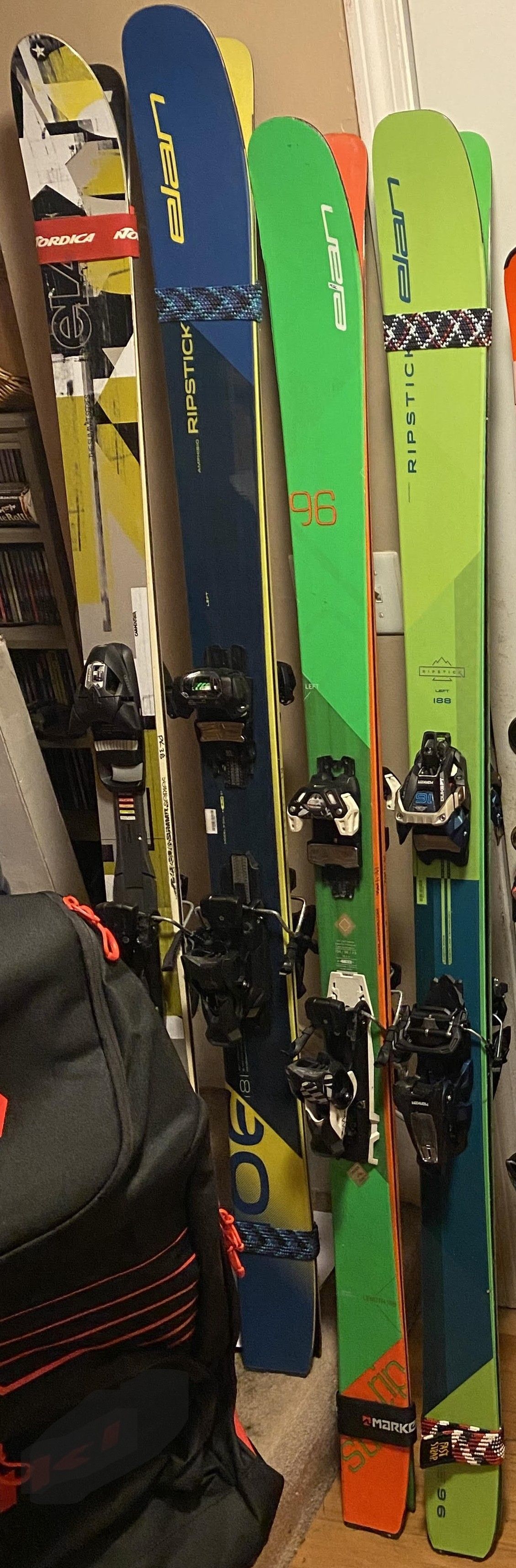
I've had three or four Ripsticks since then, and I still have a ton of fun skiing them at trail's edge, where the softer snow tends to pile up late in the New England ski day. I still have my first gen Ripstick 96 (see that fluorescent green beauty in the photo to the right), and that ski still comes out on soft snow days where the cover may not be the best. My current 96 is mounted with hybrid bindings, so I can take it beyond lift serviced terrain.
Elan continues to use Amphibio technology in most of it's skis.
Their sub-categories include:
FREERIDE:
Ripstick
Playmaker
All-Mountain:
Wingman for men
Wildcat for women
On-Piste/Carvers
Prime-TIme
Voyager (foldable travel ski)
Race
GSX
SLX
RCX
Touring
Ripstick Tour
Three generations of Freeride Ripsticks plus its predecessor.
Wingman 86 Ti
Size tested: 182
Dimensions: 134-86-114
Turning Radius: 17 m
Significant technologies:
- Amphibio Technology
- Laminated Woodcore
- Mono Ti
- SST - Slanted Sidewall Technology
The Wingman line is the journeyman all-mountain ski from Elan.
I'd call the Wingman series traditional hardpack skis, except for the fact that they are a tom of fun in soft snow and off-piste. They effortlessly glide back and forth between hardpack and soft snow, and you'll appreciate how intuitively they ski.
This year's version adds a mm of width in the shovel, which reduces the turn radius to 17 from 18+. That doesn't sound like much, but that makes it significantly more versatile in all conditions skiing.
The sweet spot for this ski is different than some old school carvers/drivers might expect.
This ski prefers a balance point where a Driver's stance should be a bit lower on the ski. I've skied with several old school skiers who had difficulty figuring this ski out, until I recommended they sit a bit lower, then roll edge to edge.
This comes out of modern race ski design, requiring far less up and down motion than years past, with the ski moving across the body while keeping the torso low and still.
Riders, using a more upright style, are, by nature, positioned over the back of the arch anyway, so they should be able to adjust to this ski fairly easily- That makes this ski versatile... a true all-mountain ski
Who should ski this ski?
- All mountain skiers who like a ski that has a carve-y feel, is extremely versatile, yet wider than most carving skis..
- Confident, hard charging, skiers who want a ski that's stable at speed.
- This ski will ski best with stiffer flexing ski boots (120-140 flex).
- Riders and old school carvers will have to drop their hips lower on this ski, or risk getting thrown at higher speed.
Wingman 86 Black
Size tested: 182
Dimensions: 134-86-114
Turning Radius: 17 m
Significant technologies:
- Amphibio Technology
- Tubelite Woodcore
- Carbon Rods/Mono TI/UD Carbon
- SST - Slanted Sidewall Technology
I tested this ski at an Elan specific demo, early season. Cover was good and the snow conditions were variable; like a late winter day where conditions started out firm then there were piles of crud later in the day.
I was very pleasantly surprised at how well this ski performs.
The personality of this ski is unique; it has power, but it doesn't feel stiff. I carves like a carving ski, but handles crud like a wider, all mountain, ski.
This ski is intuitive, predictalble, and fun.
It's surprisingly stable, yet it dances like a Ripstick and holds like a race ski, and does everything in between. That is, most certtainly, a result of the carbon rod construction (just like the RipStick leverages).
Its consistent response makes it an expert level ski that almost anyone can ski on.
When I took this ski from the demo tent, my preconception was that it would be like some of the older generation Amphibios- Sitff, stable, and heavy.
This ski was certainly stable, but that's where my preconceptions ended. It's light, it's fun, and it's one of the most versatile skis I've ever skied. This ski works, and it works well. I can't say enough good things about these skis- And, because it's not stiff, yet performs at a very high level, I understand why such a broad vase of people, from lightweight intermediates to aging, old skool, legs together veterans, love this ski.
Don't be decieved by it's carver looks- This is a true all-mountain ski. a ski that I would put right up next to a Mantra, a Maverick, a Sender, a Mindbender, or any ski in that genre, and it will perform as well or better, without the being inhibited by the slower response of a wider ski.
Who should ski this ski?
- All mountain skiers who like a ski that has can do it all.
- Confident, hard charging, skiers who want a ski that's stable at speed, yet dances like Beyonce at slower speeds.
- This ski will ski best with stiffer flexing ski boots (120-140 flex).
- Riders and old school carvers will have to drop their hips lower on this ski, or risk getting thrown at higher speed.
Ripstick 88
Size tested: 182
Dimensions: 130-90-108
Turning Radius: 16.8 m
Significant technologies:
- Amphibio Technology
- Tubelight Woodcore
- CarbonDeck Technology
- Carbon Rods/UD Carbon/Flax FIber
- SST - Slanted Sidewall Technology
Previous iterations of the Ripstick 88 were best defined as "mellow". The ski was light, soft, and damp, best for people who didn't like speed, and just wanted something easy to ski on.
This latest version of the 88 is vastly improved over it's predecessors. It's livelier, more stable, and has a more fun personality. It's has better edge grip, and is downright easy to ski.
These are. overall, sound improvements, for this model.
This ski appeals to everyone; Larger 'tweens, teenagers, adults, lower intermediates, casual advanced skiers, riders, drivers, free skiers, and casual skiers.
Who should ski this ski?
- Various types of skiers who want a solid eastern ski with a sure-footed, lively feel.
- Skiers who want something easy to ski on at slow to moderate speeds.
- This ski will ski best with
moderate to stiffer flexing ski boots (100-130 flex), as long as they are stiff laterally.
Ripstick 96
Size tested: 189
Dimensions: 134-97-115
Turning Radius: 18.8 m
Significant technologies:
- Amphibio Technology
- Tubelight Woodcore
- CarbonDeck Technology
- Carbon Rods/UD Carbon/Flax FIber
- SST - Slanted Sidewall Technology
Now in it's 3rd generation as a freeride ski, the latest iteration is the most fun yet.
Amphibio technology returns in this ski.
Amphibio is a hybrid rocker design, where the inside edge of your skis have full camber, and the outside edge is rockered.
The advantage is that you're unlikely to catch an inside ski, and have it go outrigger on you.
Most riders who ski with their feet closer together, seem to love this technology, as do Drivers, since the inner ski is less catchy/hooky than a traditional cambered ski.
The downside is that you can't switch skis to equalize the wear on your edges.
That said, since this isn't a racing ski, the edge wear isn't as extreme as it would be with a ski that's skied on hardpack/ice all the time.
Like it's predecessors, the Ripstick has no metal, which makes it lively and quick- also very versatile in multiple turn shapes. The engineering of the carbon rods make the skis very energetic and light.
This ski dances in soft snow, and holds very well on hardpack due to the UD Carbon inserts and flax fiber in the tips.
Stability at speed was the weakness of previous generations of this ski, but the added carbon and flax make this ski the dance partner that flies.
As a fringe benefit, this ski is light enough, and is quite popular as, a resort touring ski. Set up with convertible/hybrid touring/alpine bindings, this ski is your single quiver ski for multiple uses. In fact, that's how I have my current version set up.
In terms of personal experience with this ski, I've skied all 3 generations. The first generation was more of a soft snow ski; not very stable at speed, but soft and floaty in anything softer than groomed snow.
The second generation had a bit more pop with the improvement of the carbon tubes, yet still had it's limits on hardpack.
This 3rd generation ski is significantly more stable, yet retains it's dance-y feel. It's a significant improvement over Gen 2. It also finishes a turn better with a little added width in the tail
Another important point about this model line, is that the method of measurement for these is material length, instead of height. That means, the length measurement for this ski adds back the bend in the tip. For example, if you stand up a 189, then drop a line straight to the floor from the end of the tip, the height measurement is closer to 185cm. Therefore, these skis ski shorter than marked.
I've skied both the 182 and the 189, and, as a larger skier (I'm a little over 186 cm tall), prefer the 189. That said, eastern skiers looking ffor versatility in trees and spring much can certainly go one size down from head height.
This ski appeals to everyone; Larger 'tweens, teenagers, adults, lower intermediates, super-advanced skiers, rider, drivers, free skiers, and casual skiers.
Who should ski this ski?
- Various types of skiers who want a solid mid-fat with a lively feel; a dance partner, so to speak.
- Confident, hard charging, skiers who want a ski in a comfortable stance and an easy balance point.
- Experienced skiers who prefer a lively mid-fat for every day skiing, who don't like to push the speed envelope.
- This ski will ski best with moderate to stiffer flexing ski boots (110-140 flex), as long as they are stiff laterally.
Ripstick 96 Black
Size tested: 182
Dimensions: 133-96-114
Turning Radius: 17.8 m
Significant technologies:
- Amphibio Technology
- Tubelight Woodcore
- CarbonDeck Technology
- Quadrod, Carbon Frame Reinforcement, Flax Fibre
- SST - Slanted Sidewall Technology
I'm gong to approach my evaluation of these skis more like a question and answer session.
"Why?" you may ask?
Because these are the most common question I get while discussing these skis. I find it's best to just do a straight comparison as opposed to separate descriptions, especially since people come in with expectations of one or the other, anyway.
Q: What do you do when you have a ski that people rave about, yet some people complain it's not stable enough at speed?
A: You make it stiffer.
That is, after all, the conventional rule of thumb.
In conventional ski construction, metal laminates are added to make a ski more stable at speed. The net effect is the skis are stiffer, need to be going faster to start turning them, but are more stable when you go faster. Another benefit is improved edge grip, because stiffer legth-wise usually means stiffer torsionally.
Since this ski is designed without metal laminates, how do you make it more stable at speed?
Easy- you add a couple more carbon rods. So, the Ripstick 96 Black has 5 carbon rods instead of 3. That allows it to be more stable at speed without compromising its overall personality, so to speak.
Q: Does it work?
A: Yes.
Q: What was it like?
A: Ok, so I skied it in a 182 and it held up fine. I still would've preferred a 189, but the 182 worked out well.
Q: Was it more stable at speed?
A: Yes.
Q: Like, a lot faster?
A: Not really... but it was held up better at speeds one would've expected it to be nervous.
Q: Was it still fun?
Yes...
But I Love the regular 96 because it's super playful. You are sacrificing some playfulness by making it stiffer.
Of course, there are people who insist it's still super playful for heavier guys...
Well, I'm 6' 2", 240, and I prefer the non-black version.
I prefer it because when I take out the Ripstick, it's because I want to ski something super light, super playful and something super easy to ski. If I wanted a stiffer version of it, I'd take out a Canvas, or a red Sender 94 (which I already own), or something like that.
If it's your single quiver ski, then the Ripstick 96 Black makes sense for all around skiing. If you want a ski that you can tour with and ski in-resort, the regular 96 makes more sense. If you're lighter and prefer a really playful ski, the regular 96 makes more sense.
In life, there are always trade offs. Simply stated, you sacrifice some stability at speed with the regular Ripstick 96, and you sacrifice some playfulness with the Ripstick Black.
Either way, its a great ski. They're just diffrerent from each other- as one might expect.
In the end, don't overthink it- They're both great skis.
This ski appeals to everyone; Larger 'tweens, teenagers, adults, upper intermediates, super-advanced skiers, rider, drivers, free skiers, casual skiers, and everyone in between.
Who should ski this ski?
- Various types of skiers who want a solid mid-fat with a lively feel.
- Confident, hard charging, skiers who want a ski in a comfortable stance and an easy balance point.
- Experienced skiers who prefer a lively mid-fat for every day skiing, who don't like to push the speed envelope.
- This ski will ski best with
moderate to stiffer flexing ski boots (115-140 flex), as long as they are stiff laterally.
My word(s) to describe this brand for the 2024-2025 season is "". The common thread for their line was that their skis are lively and quick.

Head started it all with the Head Standard in 1950; the first wood and aluminum laminate ski for mass prodction. WIthin a year more than half the skiing public was on Head Standards. Then in 196, Head released the 360- widely considered a "cheater ski" (sound familiar?) because It adapted the high-performance, metal-laminate construction of HEAD's elite racing skis into a softer, more forgiving flex tailored perfectly for intermediate and recreational skiers. That cemented HEAD's dominance in the market during the 1960s—frequently referred to as "cheater skis" because they made high-speed skiing effortless for the average athlete.
Today , Head sports has diversified into racquet sports, winter sports, water sports and clothing.
Head Sports generates about $850 million in annual revenue, with some of the best margins in the sportig goods industry. Their company model focuses primarily on premium positioning and profitability through high-end technological innovation rather than chasing low-margin volume for mere market share.
What does that mean for you and I?
You can always count on Head to manufacture innovative and cutting edge products. They don't want to (necessarily) complete with the high volume manufacturers as much as they want to make sure they hold a niche of loyal followers.
...ain't that the truth.
Head released it's first Super Shape model in 2005 and more than 20 years later, the Super Shape comes in 5 dfferent iterations, and they're still in the top 5 carving skis on the market.
-Shoot, I taught my kids how to ski while on a Super Shape from 2007 to 2010.
In 2006 Bode Miller won races on Head race skis, cementing Head's place on the podium, even today.
In 2016 Head released the first of its Kore line, opening them up to the freeride world, where Jess Hotter won the overall Freeride World tour in 2022.
Today, Head continues to breed winners in every discipline.
Kore 100 Ti
Size tested: 177
Dimensions: 133-100-122
Turning Radius: 17.2 m
Significant technologies:
- Karuba-Beech lightweight Wood Core
- Freeride Sandwich Cap
- Tip and Tail Rocker
- Graphene
The last time I skied these, I skied them (painfully) too short.
This year, I skied them, again, in 177 (my size of choice is 184- which I got to ski on a second day).
Right off the lift I noticed that this iteration of the Kore skied much better, even at the shorter length. At full size, it skied as advertised.
It is a true freeride ski, designed to be more forgiving for Rider-type skiers. Long story short, it's not meant to be a high-speed carver; it's forte is being predictable in soft snow, and maneuvering easily in tight trees and bumps- which it does exceptionally well.
That said, with the addition of a Ti laminate, -these skis are far better as an all-around, daily driver, than any of its previous interations.
Long story short, these skis are designed to be more fun, for the masses, in the trees and in softer snow than most east coast carvers with metal laminates.
This is a great ski for skiing skiing soft snow or making skillful, smeared turns in the trees, and it can hold up on groomers for your average, everyday skier.
Who should ski this ski?
- This is your classic Rider's ski. Every Rider I know loves it.
- Confident, intermediate through advanced skiers who want a ski that they can take into the woods and ride smeary turns through bumpy terrain.
- This ski will ski best with moderately soft to stiffer flexing ski boots (100-130 flex).
- Drivers/carving style skiers who are looking for a ski that carves high speed, long radius turns on hardpack may not like this ski- it has a loose feel on hardpack, and has a smeared finish.
My word(s) to describe this brand for the 2024-2025 season is "". The common thread for their line was that their skis are lively and quick.

Traditional Power

Kastle has, for the most part, been a boutique brand in the USA. It is known as, and renowned for, a brand of skis made with a lot of power. Kastle's DNA IS racing and their following has always been a loyal one- mostly an Austrian crowd since they are an Austrian ski company.
Kastle has always leveraged metal laminates in their ski construction, which goes hand-in-hand with a racing philosophy.
Over the years, the bigger players have pushed Kastle to the side a bit, with three men and three woemn on the FIS WC circuit still skiing them. They've made a bit of a splash in the freestyle market as their mogul ski is quite impressive, and they have a competition bump skier doing very well on them.
They've slipped a bit into obscurity over the last ten years, as their R&D seems to have fallen bit behind. The graphicsw don't appeal well to a US crowd, and they've struggled a bit getting their target markets figured out. They have, like other manufacturers have already tried and moved past, made their skis with exceptionally large sweet spots (see the Volkl Deacon and Stockli ar)- which, makes the skis sluggish. While that does make balancing on them much easier than prior years, that leaves only hte doctor lawyer crowd finding them fun to ski on, and, as we all know, that crowd are all dedicated followers of fashion and trends. So, long story short, they've double-whammied themselves and alienated their base market (hardcore rippers) while not really bringing in the big money customers.
All that aside, I have complete faith that Kastle will figure it out, as they still have a few skis that hit the mark for both performance and skiability, in the MX74 and the Paragon 101.
Keep the faith Kastle purists.
MX 74
Size tested: 178
Dimensions: 123-73-103
Turning Radius: 11.3-13.4 m
Significant technologies:
- Infini core AMTM (Poplar-Beech)
- Double Titanal
- Full Race Sidewall
- Hollowtech EVO
- Standard Camber
Direct out of Kastle's power-carver traditions, is the MX 74.
This is the perfect narrow width carver, with full camber and full race sidewall. This is, easily, a ski that you can free ski and use for beer league and non-FIS sanctioned (NASTAR) courses.
It comes from the factory tuned at .8/2 degrees, which makes it a great all-mountain carver, but change that to .5/3 degrees and you have a race-bred machine that will have you winning races and bragging in the bar, Wednesday nights, as you all watch the video feed from the evening's festivities, while munching on your double jerk, triple spicy chicken wings with honey-hot sauce.
These skis have low effort power, that you can push, and push, and push with no limits. With (what amounts to) a 14 meter radius (for most sizes) it's more than versatile enough for all mountain and race night skiing.
With all that said, let me remind y'all that this is definitely a front side machine. Most modern skiers arent attuned to full camber skis. Being in the all-mountain category, it does have a bit more of a slightly more forgiving sweet spot, and a rounder turn shape- but, if you're not used to rolling over a fully cambered ski (like a race ski) you'll find yourself lifting or launching to transition turns. So, I think most modern riders (freeride skiers) will think this ski isn't a whole lot of fun- and that's ok. This is truly, a drivers' carving machine; meant for hip draggers who can keep both skis glued to the snow in all conditions.
As for what makes it all mountain... that speaks to its versatility on hardpack/groomers. Anything more than a couple inches of fresh or soft snow and you'll need to compensate with a soft touch and a more significant unweight at the transition.
So, for you Kastle carving purists who are looking for a better all-mountain Kastle, this is your ski- The MX74 handles the best of both worlds with the traditional power and edge grip Kastles are renowned for, and the versatility required for modern day, east coast, hardpack conditions.
For best results, ski this ski full length. Skiing it shorter tightens the sweet spot, making it more demanding (it also gives it more kick out of the turn). If you're looking for a more traditional slalom ski, and want to ski it like a shorter race ski, fine, have at it. But you'll lose that more forgiving sweet spot that makes it all-mountain friendly, not to mention the rounder turn shape might make it feel a bit hooky.
Who should ski this ski?
- Any advanced skier, who wants a ski that has good power, and carves well.
- Skiers who are looking for a hip-dragging carver that can give back everything you put ino it.
- Skiers who prefer to ski front side hardpack, or who have other skis for conditions other than hard pack.
- This ski will ski best with a stiffer flexing ski boot (120-150 flex)
Paragon 101
Size tested: 184
Dimensions: 135-101-122
Turning Radius: 18m
Significant technologies:
- Triple wood Infini core FREE (Poplar-Beech-Paulina)
- Double Titanal
- Hook Free Dual Rise | Progressive Rise
- Hollowtech 2.0
"Titanal reinforced" is all you need to know about this skis' bloodlines. Kastle has never been afraid of using metal laminates, and the edge grip on this ripper will show you why. People who ski Kastles do so for their unlimited power and stability.
True to its reputation, if you set this ski on edge and apply some power, it will carve like a race ski (emphasis on power).
That same power, driven through spring crud, slush, and soft snow, makes it a real speed machine in all conditions.
But can it float in soft snow?
Yes- One of the miracles of modern ski construction was in realizing that modern construction materials and processes allowed manufacturers to reduce the camber, then add some rocker in the tip (and in many cases, such as with the paragon line, the tail as well) to make the skis more forgiving. Take that a step further by tweaking the sidecut a bit, and suddenly you have a pair of skis that are easier to ski on, without sacrificing much overall power, and making them more fun.
So, for you Kastle purists who are looking for a better all-mountain Kastle, this is your ski.
For you strong, east coast, skiers who want a great ski for the east coast, with some power, this is your ski.
For best results, ski this ski full length. Skiing it shorter tightens the sweet spot a bit, making it more demanding (it also gives it more kick out of the turn).
Who should ski this ski?
- Any skier beyond intermediate, who wants a ski that has good power, and carves well even at a 101 width.
- Skiers who are looking for a versatile, all-conditions, ski with the power to hammer through anything.
- Skiers who prefer to ski a full length ski- Downsizing not recommended for most skiers.
- This ski will ski best with a stiffer flexing ski boot (115-140 flex)
Irreverant

Optic 104
Size tested: 185
Dimensions: 132-104-123
Turning Radius: 19m
Significant technologies:
- Aspen Veneer
- Gas Pedal Metal
- Directional Twin
- 5 Cut Sidecut
- Early Rise tip and tail rocker
This is a directional twin. Changes this year include more rocker tip and tail, with a tightened-up camber profile. It retains the depth of camber in last year's model, but over a shorter distance from the center mark (because of more rocker). I wrote a review on this ski last year, and the year before, even though it hasn't changed in a couple years.
I'm writing another one this year, because, frankly, the ski deserves it.
I've ranted and raved about how well this ski does in hardpack and crud. This time, I got to ski it in real powder.
I skied up to the Line tent, said hello to the rep, smiled at him, and asked for the Optic 104. He, knowingly smiled back, and said, "Good choice!", because, it was.
I took that up to the poma at Waterville where cold, fresh snow was dumping all night and throughout the day, with blower refill.
The versatility of this ski is something to marvel at. It's fun, easy to ski. has good power, and does anything you want it to do.
As I've said before, carve it hard on hard pack, plow through crud, rage in powder, get steezy on anything, and it responds with a smile.
These are great skis.
I finally broke down and bought a pair.
You should too.
Who should ski this ski?
- Experienced skiers who want a super-versatile directional twin.
- Confident, hard charging, skiers who like to play AND ski fast.
- Experienced skiers who prefer one ski all day, every day in the form of a directional twin tip.
- Skiers who prefer to ski a full length ski or downsize one size below head height
- This ski will ski best with a
moderate to stiffer flexing ski boot (115-140 flex)
SOLID

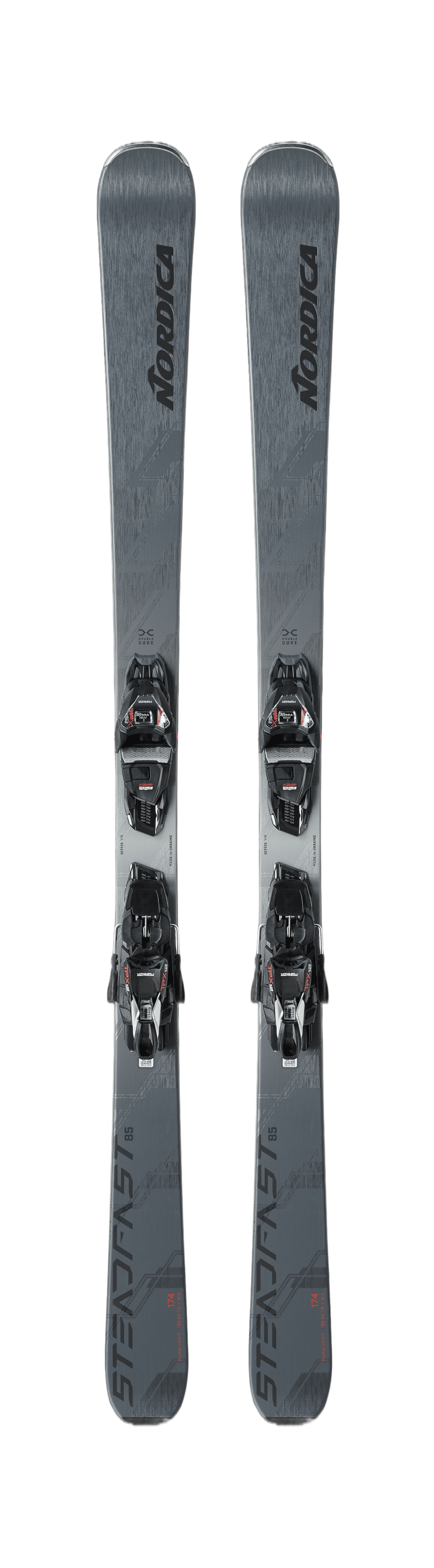
Steadfast 80 DC TP2
Size tested: 179
Dimensions: 126-78-105
Turning Radius: 12.8m
Significant technologies:
- Double Core
- Performance Wood + Metal + Pulse Core + Sidewall
- FDT Race Plate
- Full Camber
The Steadfast 80 Sandwiches a sheet of elastomer between two wood layers. This gives the ski exceptional vibration dampening and stability without loss of power. A rare few other manufacturers have mastered the use of elastomers in their core, and those who did created a line of skis that shine as hardpack carving machines- just like this ski.
This ski is playful and forgiving yet has great edge-hold when you set the edge.
It’s also a solid hardpack carver, with enough versatility to handle some heavy crud. It’s quite stable at speed, and it handles well overall. It’s a steady and predictable ski- a classic feel with good edgegrip and stability.
Who should ski this ski?
- All-mountain skiers who like a ski that's easy to skid, with versatility as it relates to turn shape and speed.
- Confident skiers who want a ski that rolls edge to edge very quickly, yet they can use it all over the mountain.
- This ski will ski best with
moderate to stiffer flexing ski boots (120-150 flex).
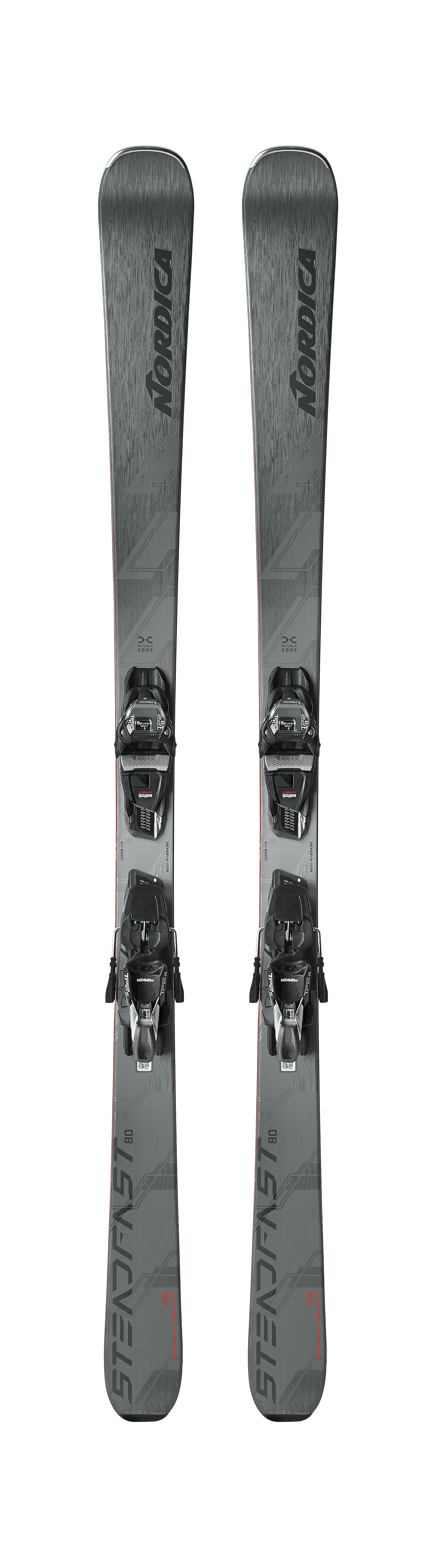
Steadfast 85 DC TPX12
Size tested: 179
Dimensions: 137-85-116
Turning Radius: 15.8 m
Significant technologies:
- Double Core Titanal
- Performance Wood + Metal + Pulse Core + Sidewall
- FDT HP Free Plate
- On Piste Rocker
This ski has a similar personality to the DC 80, with a little more hourglass to its shape. That made it a bit easier in terms of turn shape, speed, and turning on steeper pitches. It’s solid on hardpack, and drives though crud fairly well. It was a bit less stiff than the Spitfire 80, thus less powerful, but the dual core/elastomer construction makes it surprisingly quiet and consistent. I consider it to be a less limiting, more versatile carving ski for more varied pitches.
For skiers who prefer a more shapely, yet powerful ski in trees, the shorter radius turn of this ski makes it a great choice.
This ski was solid and steady underfoot. On hard pack and in crud. “Steadfast” is a good name for this ski, since it's very quiet and very stable.
Who should ski this ski?
- All Mountain skiers who like a carving ski that's powerful, with versatility as it relates to turn shape and speed.
- Confident, hard charging, skiers who want a ski that they can use in a beer league/Non-FIS race then go out and ski the rest of the night with the crew and have fun.
- A carving ski with a bit more versatility than most carvers.
- This ski will ski best with
moderately stiffer flexing ski boots (110-150 flex).
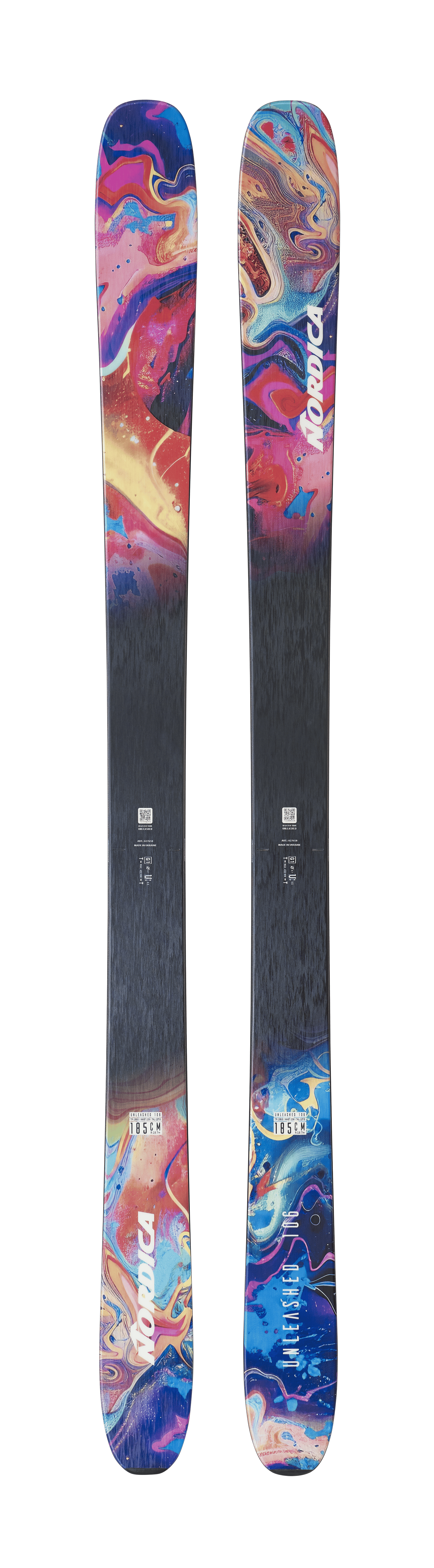
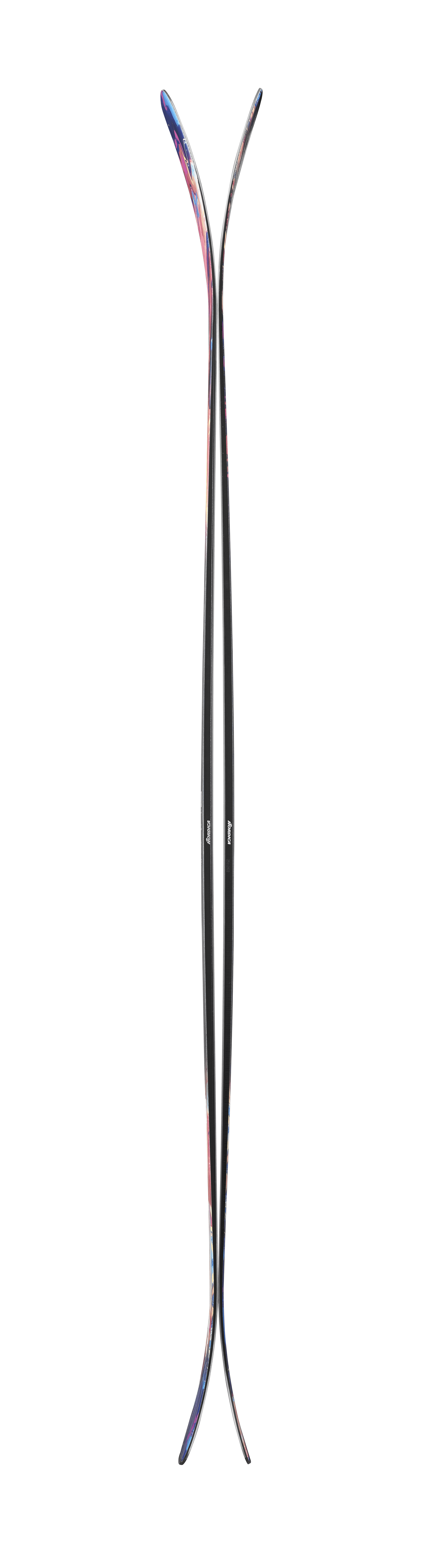
Unleashed 106
Size tested: 185
Dimensions: 138.5-106-127.5
Turning Radius: 18.7 m
Significant technologies:
- Drift Lock Metal
- Lite Performance Wood + Drift Lock Metal + Carbon + Sidewall
- Freeride Flow Shape
- True Tip
I was lucky enough to ski these on both very hard packed snow and on a true east coast snow day.
By "true east coast snow day", I mean over 8" of snow with wind blown refill- A rare opportunity to test wide skis, for real.
I tested several wide skis that day, but the standouts were the Rossi Soul 110 and The Unleashed 106.
Both excelled that day, but they have very different personalities.
-no comparisons here-
Except to say both skis were absolutely FEARLESS and unmatched in these conditions.
Speaking of the Unleashed, specifically-
These are the full metal version. The CA has carbon stringers instead of a metal laminate; they turn shorter and are more playful.
The standard 106 (with metal laminate) is a powerhouse- a rocket ship straight out of Star Trek (psychedelic retro 60s color scheme and all). I hard-charged these at warp factor f*ck you for half the day without getting tired, or needing to slow down.

They were fast, stable (INCREDIBLY STABLE), versatile, and intuitive.
*They're named "UNLEASHED" for a f#cking reason*
They were insanely easy to ski in soft snow, then as I cleared the upper mountain to the scrapy lower section, they held like carving skis and plowed through crud like it wasn't there.
These skis WANT you to go fast...
They don't hint at it-
They don't whisper it in your ear-
They scream from the roof tops and the lift chair; "GTFOH, because, FU... that's why"
Yet, ironically, they handle exceptionally well at slower speeds and in tighter, medium radius turns.
They just want to go fast because they can.
These are seriously fun and intuitive skis. Be prepared to scare yourself because they're so stable you realize you can just ski them (in full zen flow), then, at some point, you'll find you're passing people like you're passing sign posts on the highway.
Sh*t , these were fun.... REALLY fun.
Daddy wants a pair.
As for which size to ski, ski them normal size (head height). No need to up or downsize- They are incredibly versatile, at the correct length, in all conditions.
Can these be single quiver skis on the east coast?
Yep- as long as your knees can handle a 106 all day long.
Who should ski this ski?
- All Mountain skiers who want to have fun!
- Confident, hard charging skiers who want a ski that they can trust in ANY conditions.
- This ski will ski best with stiffer flexing ski boots (115-150 flex).
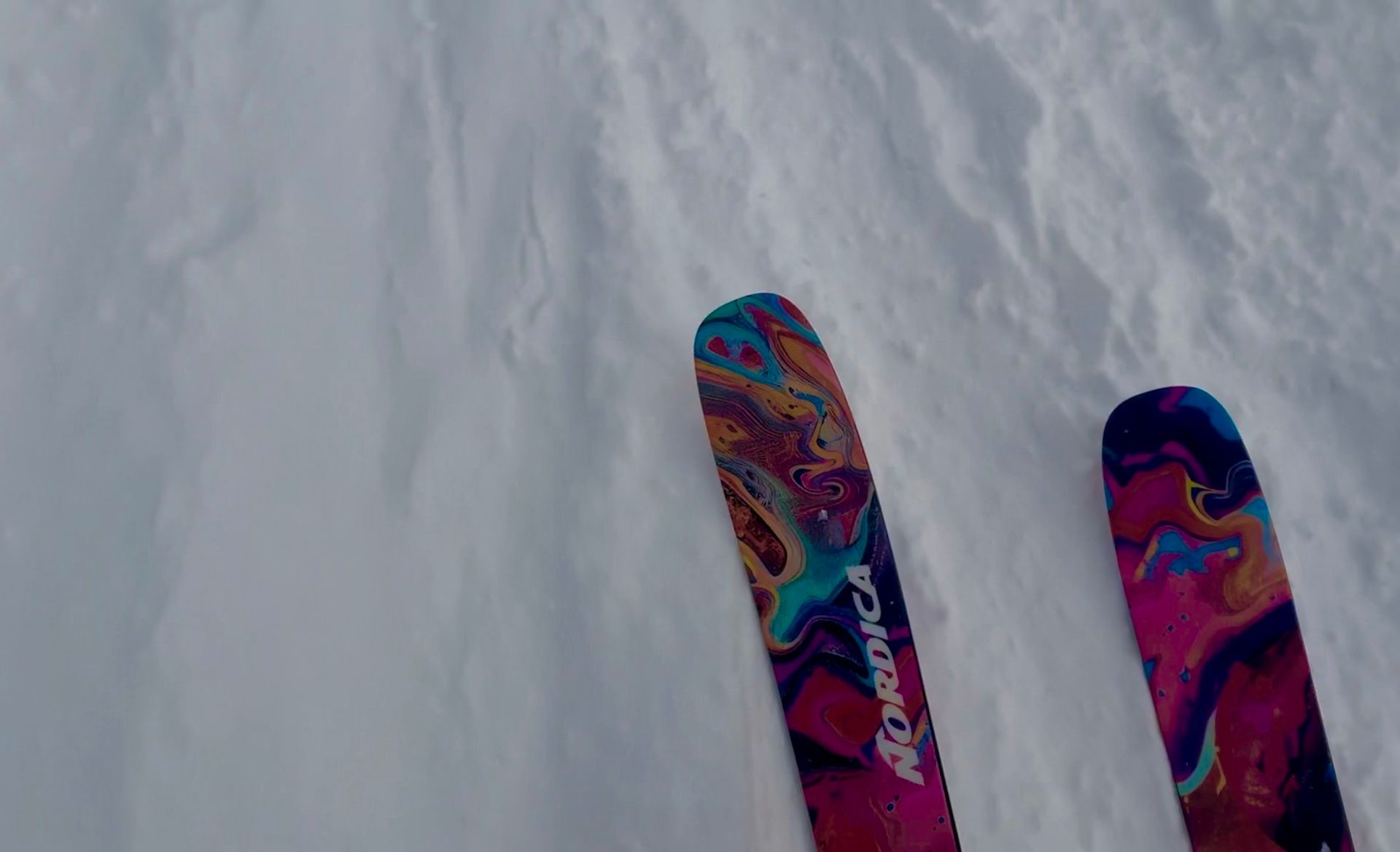
A quick snip coming off the lift 2-11-26
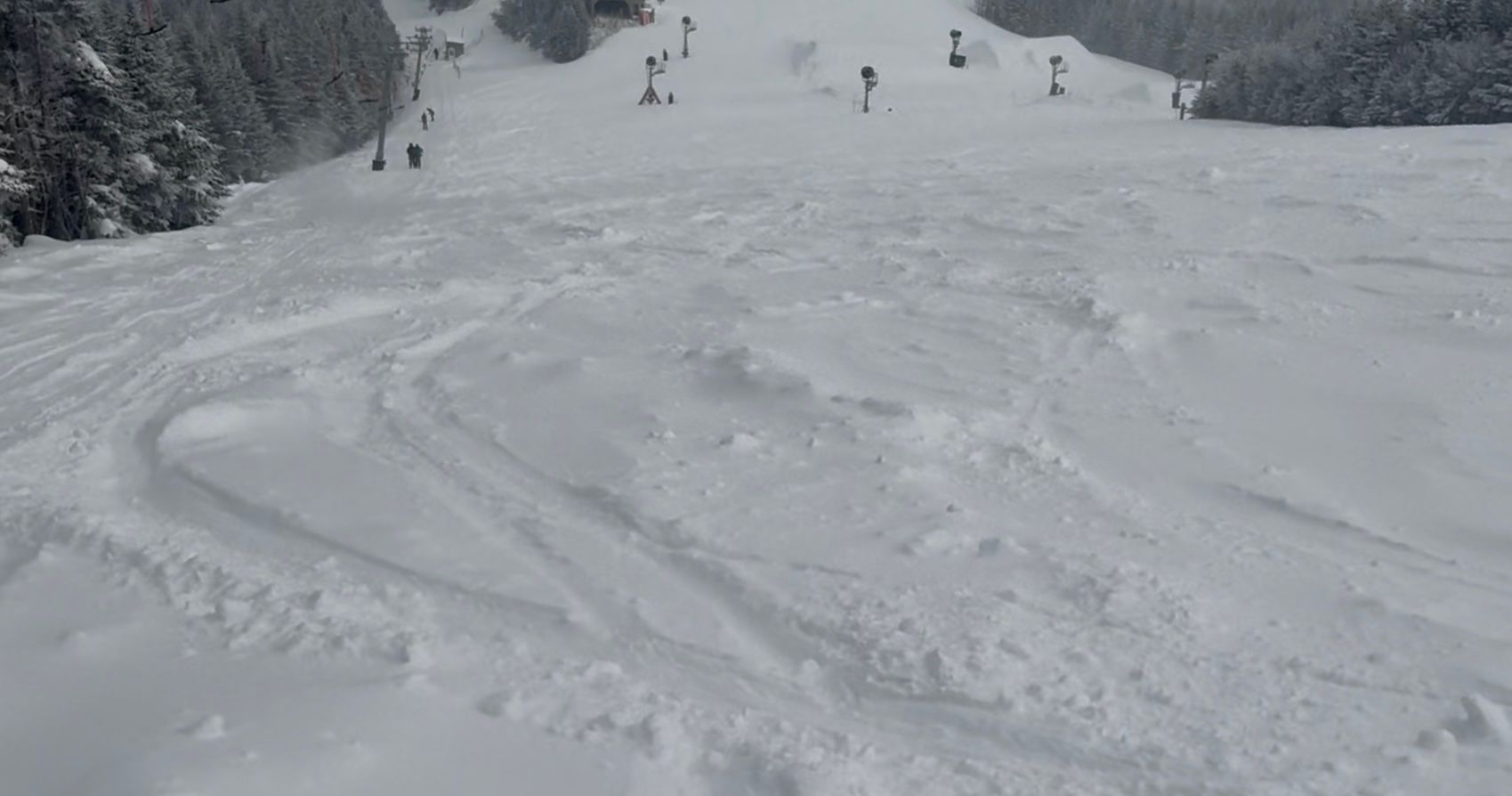
A rare east coast dumping at Waterville Valley 2-11-26
LIGHTWEIGHT POWER

Rossignol has made great strides over the past four years- They've completely revamped their line, and are leading the industry with their ground breaking freeride skis The Sender, Sender Soul, and Soul, models do not disappoint.
In addition to that, they've created the Arcade line, which, while listed on their site as "All Mountain", they absolutely blow the old EXP line out of the water with their versatility, edge grip, and ease of skiing- not to mention a new level of stability that their Ti I-beam and updated integrated V.A.S. system upgrades provide.
They've also introduced some expanded color schemes, with matching bindings, for many models, referring to them as the "SUPER" model (Super Arcade, Super Arcade 84, Super Black Ops, etc.)
Their sub-categories include:
MEN::
FREERIDE:
Sender (playful, lightweight- replaces the older SOUL/SOUL 7 models. -also formerly sender soul- Lighter, and more playful, than the first gen Sender models that had a full sheet of Ti. Super easy to ski on, yet experts still love the performance-Exceptional edge grip for this genre ski)merly sender soul- Directional twin design with more rocker tip than tail-Surfy, versatile and predictable. Very playful yet not weak or noodly. They also have a bit more of a direction feel)
Super Black Ops (A bit less surfy than the Sender Soul and Sender free, with superior edgegrip and stability, yet still playful and agile)
ON PISTE:
Forza (Carving skis- more extreme sidecut)
Essential (Created with an environmentlaly conscious mindset, also lots of shape)
ALL MOUNTAIN:
Arcade (The do everything ski that carves like it's on rails, yet handles rough terrain with aplomb)
UNISEX:
Rossignol places an Arcade 84, 88, and 94 in the unisex category, along with their race skis. However, note the difference between the "unisex and Konect" versions of the Arcadeskis are in name only.
*NOTE- The Arcade 94 Women's is actually the unisex Arcade 94 with the Konect system bindings.
RACE:
Hero Elite (Non-FIS- for strong technical skiers who want a race-style ski)
Hero Master (A step up from the Hero Elite, also non-FIS)
Hero Athlete (U14-U16 level FIS skis)
Hero A FIS FAC (Ladies FIS)
Hero FIS (FIS Race)
FREERIDE:
The Super Black Ops crosses over into the Unisex category, as does the Sender/Sender Free/Soul and most HERO models.
WOMEN:
FREERIDE:
Sender (playful, lightweight- replaces the older SOUL/SOUL 7 models. -also formerly sender soul- Lighter, and more playful, than the first gen Sender models that had a full sheet of Ti. Super easy to ski on, yet experts still love the performance-Exceptional edge grip for this genre ski)
Soul (formerly sender soul- Directional twin design with more rocker tip than tail-Surfy, versatile and predictable. Very playful yet not weak or noodly)
Rallybird (These are like the previous generation senders for men- Very light, usually a Pawlina wood core, directional, playfuul, yet stable at speed)
Rallybird Soul (Similar to the Rallybird but a little more surfy; Modified twin-tip, mostly directional shape)
ON PISTE:
Nova: (Carving machines with great edge grip and a big sweet spot to make them fun and easy to ski on. Your partner for all-day groomers)
ALL MOUNTAIN:
Arcade: (All mountain versatility with edge grip to rival race skis, yet fun and easy to ski on)
Rossignol changed the game when they developed the Forza, a few years back. They created a ski with a big enough sweet spot to be fun and forgiving, yet gave it the torsional rigidity to hold like it's on rails, and the core construction to make the ski powerful yet consistent; no more getting launched off the tails because of counter flex, and they're as stable as you dare. The lessons they learned here from translating race technology to consumer models helped them pass down those positives to their entire ski line. Add these changes to their forward mounting points, and you have a ski line that is more agile across the board.
They've broken the mold with their Arcade, Soul, and Sender lines- winning free ride awards in just about every competition and event. They are the new standard in Freeride and all mountain skiing.
This year they've updated their Race line with a modified "V" sidecut. That type of sidecut (other manufacturers have used it over the years) tends to give skis a more versatile turn shape. A typically rounder shaped sidecut -like this )( - tends to force the turn into a specific shape. The "V allows a skir to adjust, on the fly, tobetter adapt to modern race course sets.
Rossignol is the real deal; it's no longer your grandfather's ski, and that has people exclaiming "Rossignol est meilleur"!

ALL MOUNTAIN
Arcade 78 XPRESS
ALL MOUNTAIN
TARGET SKIER: INTERMEDIATE
SYSTEM BINDING: YES
DIMENSIONS: @172 CM 129-78-117
RADIUS: 13M
Arcade 80 XPRESS
Arcade 82
Arcade 84
Arcade 88
Arcade 94
Arcade 78 XPRESS W
ALL MOUNTAIN
TARGET SKIER: INTERMEDIATE
SYSTEM BINDING: YES
DIMENSIONS: @156 CM 129-78-117
RADIUS: 11M
Arcade 80 XPRESS W
ALL MOUNTAIN
TARGET SKIER: INTERMEDIATE
SYSTEM BINDING: YES
DIMENSIONS: @158 CM 130-80-118
RADIUS: 11M
Arcade 82 W
ALL MOUNTAIN
TARGET SKIER: INTERMEDIATE
SYSTEM BINDING: YES
DIMENSIONS: @160 CM 132-82-120
RADIUS:12M
Arcade 84 W
ALL MOUNTAIN
TARGET SKIER: INTERMEDIATE to ADVANCED
SYSTEM BINDING: Available with and without
DIMENSIONS: @160 CM 132-84-12
RADIUS: 15M
Arcade 88 W
ALL MOUNTAIN
TARGET SKIER: INTERMEDIATE to EXPERT+
SYSTEM BINDING: Available with or without
DIMENSIONS: @162 CM 135-88-124
RADIUS: 13M
Also available UNISEX
Arcade 94 W
FREERIDE
Sender Soul 92
FREERIDE
TARGET SKIER: INTERMEDIATE TO LIGHTWEIGHT ADVANCED
SYSTEM BINDING: NO
DIMENSIONS: @176 CM 122-92-112
RADIUS:20M
Sender 100
FREERIDE/FREERIDE PARK
TARGET SKIER: INTERMEDIATE TO ADVANCED
SYSTEM BINDING: NO
DIMENSIONS: @178 CM 131-100-123
RADIUS:18M
Sender Free 118
FREERIDE
TARGET SKIER: ADVANCED - EXPERT
SYSTEM BINDING: NO
DIMENSIONS: @176 CM 146-118-141
RADIUS:20M
Rallybird 94
FREERIDE
TARGET SKIER: ADVANCED - Intermediate to EXPERT
SYSTEM BINDING: Available both as open and with XPRESS
DIMENSIONS: @164 CM 127-92-117
RADIUS:14M
Rallybird Soul 92
FREERIDE
TARGET SKIER: INTERMEDIATE
SYSTEM BINDING: NO
DIMENSIONS: @156 CM 122-91-112
RADIUS:20M
Super Blackops
FREERIDE
TARGET SKIER: INTERMEDIATE
SYSTEM BINDING: NO
DIMENSIONS: @172 CM 131-98-121
RADIUS:17M
ON PISTE
FORZA 40D V-CA
ON PISTE
TARGET SKIER: INTERMEDIATE TO LIGHTWEIGHT ADVANCED
SYSTEM BINDING: YES- XPRESS SYSTEM
DIMENSIONS: @171 CM 128-75-111
RADIUS:14M
FORZA 50D V-CAM
ON PISTE
TARGET SKIER: INTERMEDIATE TO ADVANCED
SYSTEM BINDING: YES- XPRESS SYSTEM
DIMENSIONS: @171 CM 128-75-111
RADIUS:14M
Forza 60' TI
ON PISTE
TARGET SKIER: INTERMEDIATE TO LIGHTWEIGHT ADVANCED
SYSTEM BINDING: YES- XPRESS SYSTEM
DIMENSIONS: @171 CM 130-75-112
RADIUS:13M
FORZA 70' TI KONECT
ON PISTE
TARGET SKIER: ADVANCED TO EXPERT
SYSTEM BINDING: YES- KONECT SYSTEM
DIMENSIONS: @173 CM 134-77-110
RADIUS:14M
Forza 70' TI+ Master R22
ON PISTE
TARGET SKIER: ADVANCED TO EXPERT
SYSTEM BINDING: NO- PLATE
DIMENSIONS: @173 CM 134-77-110
RADIUS:14M
Essential Open
ON PISTE
TARGET SKIER: UPPER INTERMEDIATE TO ADVANCED
SYSTEM BINDING: NO- OPEN
DIMENSIONS: @172 CM 122-69-103
RADIUS:14M
MOGULS
HERO MOGUL ACCELERE OPEN
ON PISTE
TARGET SKIER: ADVANCED TO EXPERT
SYSTEM BINDING: NO
DIMENSIONS: @165 CM 107-65-87
RADIUS:18M
HERO ATHLETE MOGUL ACCELERE FACTORY OPEN
ON PISTE
TARGET SKIER: WORLD CUP MOGUL SKIERS
SYSTEM BINDING: NO
DIMENSIONS: @172 CM 92-63-81
RADIUS:26M
-RACE-
RACE BRED CARVERS
HERO ELITE ST TI KONECT
RACE
TARGET SKIER: ADVANCED-EXPERT RACER
SYSTEM BINDING: YES- KONECT
DIMENSIONS: @167 CM 123-68-104
RADIUS:13M
HERO ELITE MT TI C.A.M. KONECT
ON PISTE
TARGET SKIER: ADVANCED RACER/CARVER
SYSTEM BINDING: YES- KINECT
DIMENSIONS: @175CM 124-74-109
RADIUS:15M
HERO ELITE LT TI KONECT
MASTERS RACERS
HERO MASTER ST R22
ON PISTE
TARGET SKIER: RACE EXPERT
SYSTEM BINDING: NO
DIMENSIONS: @165 CM 118-67-104
RADIUS:13M
HERO MASTER LT R22
ON PISTE
TARGET SKIER: ADVANCED TO EXPERT
SYSTEM BINDING: NO- PLATE
DIMENSIONS: @179 CM 115-70-97
RADIUS:19M
U14-U16 RACERS
HERO ATHLETE SL 150 R22
ON PISTE
TARGET SKIER: U14 TO U16 RACERS
SYSTEM BINDING: NO
DIMENSIONS: @150 CM 115-65-101
RADIUS:11M
HERO ATHLETE GS 170-185 R22
ON PISTE
TARGET SKIER: U14-U16 RACER
SYSTEM BINDING: NO
DIMENSIONS: @175 CM 102-65-85
RADIUS:23M
FIS RACERS
HERO A FIS SL FAC 157 R22
ON PISTE
TARGET SKIER: FIS SLALOM RACERS
SYSTEM BINDING: NO
DIMENSIONS: @157 CM 119-66-102
RADIUS:12M
HERO ATHLETE GS 170-185 R22
ON PISTE
TARGET SKIER: U14-U16 RACER
SYSTEM BINDING: NO
DIMENSIONS: @175 CM 102-65-85
RADIUS:23M
HERO A FIS GS FAC 188 R22
ON PISTE
TARGET SKIER: WOMEN'S FIS GS
SYSTEM BINDING: NO- PLATE
DIMENSIONS: @188 CM 101-65-81
RADIUS:30M
HERO ATHLETE FIS DH HARD
ON PISTE
TARGET SKIER: FIS DH RACERS
SYSTEM BINDING: NO
DIMENSIONS: @218 CM N/A119-66-102
RADIUS:50M
ALL-MOUNTAIN:
ARCADE
The Arcade series was new for 2024-25, with the introduction of the Arcade 84 and 88.
Last year, the line was expanded to include 80, 82, and 94 mm widths.
That rounds out the line to include:
80 and 82 mm for intermediate to casual advanced skiers
84, 88 and 94 for upper intermediate through advanced skiers.
You can also find some limited edition versions as:
Arcade 94: SUPER ARCADE
Arcade 84: SAVAGE, SUPER ARCADE
(Beyond the Arcades the Forza, Soul 102, and Super Black Ops are also available in limited edition colors).
You can find the 94 with the KONECT binding system, but they mistakenly refer to it as a women's ski. I think it's a typo, so we will have to see if they correct it in time.
All, except The Arcade 80, have full sidewall construction, so they accomodate all skiers from intermediate through race ability and aggression.
I'm a big fan of the Arcade models, across the line- Here's why...
The 80 and 82 are surprisingly fun skis. Exceedingly easy to ski on, yet they have great edge grip and are predictably agile. There are no worries that these skis can't hold up, or that they will be unforgiving in some conditions. For skiers looking for something a little less stiff, and a little less aggressive, yet they can take you anywhere and you'll have fun getting there.
The Arcade 84 has a sheet ot Ti under the bindings, extending a bit towards tip and tail, but not full length. The idea there is to allow more flex tip and tail to give that ski a "turnier" personality. In other words, it's easier to turn at slow speeds than the 88.
The Arcade 88 has a full-length sheet of Ti, which stiffens the ski, and gives it a "racier" personality. That full sheet significantly increases the power profile for a ski that's meant to power through crud and hold like it's on rails- which it does exceptionally well. The 88 is "Best in Class" for that genre ski.
The Arcade 94 has the same construction as the 84, which allows this ski to be a bit flexier tip and tail makes it more playful, without sacrificing ANY edgegrip.
The Arcade 94 remains one of my all-time favorite skis.- I found it to be the most versatile ski in the entire mix, without sacrificing performance in any conditions. Many skis with an "all-around" skill set are fairly boring, as they don't excel at any one thing (carving, soft snow, bumps, higher speeds, etc)- that's not the case here. This ski is fun, agile, and exciting whatever you do with it. The 94 is truly, the perfect "one ski quiver" ski.
One last note about the Arcade line-
The Konect system, with these skis, adds a fringe benefit of additional power to the skis. The extra hight off the skis adds a bit of response, just like binding lifters did back in the 1990's and early 2000s. It's enough of a difference to be noticeable. Just remember that adding height to where the boot sole sits makes a ski a little slower edge to edge. Plus, The Rossi Konect system is the real deal. If they trust it on their Hero line, then you should trust it over their entire line. They're a bit more difficult to adjust, but that's something you shouldn't have to worry about.
Arcade 80
Size tested: 182
Dimensions: 130-80-118
Turning Radius: 14m
Significant technologies:
- PEFC Poplar Core with LCT
- Fiberglass
- Cap
- V-A-S
- Extended Sidecut
- Tip and tail rocker
- Color: Silver/Grey with Royal Blue
-No testing notes available yet-
Who should ski this ski?
- Any skier beyond beginner level, up to a lightwieght, casual experienced skier, who wants a ski that's quick and easy edge-to-edge, that carves well and is easy to pivot at slow speeds.
- Skiers who are looking to build their confidence on a ski that's easy to turn and relatively stable at moderate speeds.
- Skiers who prefer to ski a full length ski or downsize one size below head height.
- This ski will ski best with a
Moderate to stiffer flexing ski boot (100-120 flex)
Arcade 82
Size tested: 184
Dimensions: 132-82-120
Turning Radius: 15m
Significant technologies:
- PEFC Poplar Core with LCT
- Carbon Beam
- Rectangular full sidewall
- V-A-S
- Extended Sidecut
- Tip and tail rocker
- Color: Grey
I got to ski this ski in clumpy conditions, on an overcast day after some significant snowfall.
In short, conditions were trails with solid hardpack, and trails with crud.
In the past, it was common for ski manufacturers to make skis of different widths, within a genre (in this case, all mountain skis), just narrower versions of each other, with varying degrees of metal to change the performance level. In short, more metal makes a ski stiffer and more able to dampen vibration at higher speed. So, a higher level skier would get skis that required more strength to ski, but it would handle the higher speeds and have the edge grip performance skiers require.
That is certainly the case here; these skis are easy to ski- they turn very easily, and are super-versatile.
What Rossi got right IN ADDITION to those things, is making the sweet spot more appropriate for that level skier.
These skis allow for a more upright skier to handle them easily, yet thry have enough edge grip and power to not be boring.
They're great for that skier who is stepping up into intermediacy, elder skiers who don't want to work so hard but also don't want to be bored by their skis, or that person who claims to be an "eternal intermediate" because they're not aggressive or never leave blue and green trails. These skis are fun. easy to ski, and handle varied conditions quite easily.
Who should ski this ski?
- Any skier beyond beginner level, up to a lightwieght, casual experienced skier, who wants a ski that's quick and easy edge-to-edge, that carves well and is easy to pivot at slow speeds.
- Skiers who are looking to build their confidence on a ski that's easy to turn and relatively stable at moderate to higher speeds.
- Skiers who prefer to ski a full length ski or downsize one size below head height.
- This ski will ski best with a Moderate to stiffer flexing ski boot (100-120 flex)
Arcade 84
Available Open (without binding) or Konect (with system binding)
Size tested: 184
Dimensions: 132-84-120
Turning Radius: 16m
Significant technologies:
- Poplar Core with LCT
- Titanal Beam
- Rectangular full sidewall
- V-A-S
- Extended Sidecut
- Tip and tail rocker
- Color: Grey/Green
I skied this ski twice, on two days with very different conditions. The first day I skied it in a 176, and the conditions were cruddy and choppy; your typical east coast cement after more than half a day of skiers making a mess of things. The light was flat, and visibility was poor. It wasn't my favorite day; I usually back it down a bit when visibility is poor, unless I know the place I'm skiing very well. After a few runs of skiing with some very good skiers, I realized I didn't have to be tentative. This ski thrived in these condtions. They didn't mind the cruddy snow one bit, and I didn't have to adjust anything to make the ski do what I wanted it to do.
It wasn't long before there were patches of ice followed by piles of heavy snow as the hill continued to get skied off. When the snow gets like this I like to put a ski on edge and rip higher speed GS turns. This ski didn't even notice that the snow was awful. It held great on the scrape, and powered right through the muck. I was both relieved and pleased that I could relax and just let this ski do its thing.
The second day I skied it, I got to ski the 184. It was sunny and cold, with New England hard pack (not quite icy broilerplate, but really firm with scraped off sections. This ski held like a race ski, yet it was really easy to put it in "carve mode" and just go. This ski really does everything very well, does it at a level a racer would expect, yet it's easy enough to ski on that an intermediate would be smiling all day. The sweet spot, on the full sized ski, is pretty big, making it comfortable for most skiers from an intermediate through advanced skier to ski on.
This is available in a Konect version, or "Open" (flat- you need to buy separate bindings)
KONECT VERSION: It comes with SPX 12 bindings on the integrated Konect track system The konect system is pretty burly, so the the bindings are a bit heavy (that's what happens when you design a track system for race bingings).
OPEN VERSION: put your bindings of choice on them.
***COLOR DIFFERENCES: Many people comparing these two versions on the website think they are different colors. This is not the case; these are a greenish brown color with some blue-gray shading at the tip and tail. Web page color rendering is voodoo, especially if the photos for the skis were taken with different cameras.
I've adjusted the color saturation on this photo to emphasize that.
It was also released with the "SAVAGE" graphic; basically tiger stripes with pink and yellow highlights. I almost bought one, then decided I didn't want to entirely reconsider my life choices. I'll leave that color scheme to the Euro crowd.
It comes with a 2 degree sidewall and 1 degree base, but you could, certainly, go to 3 degree sidewall on it. Just remenber it becomes a carving machine, and intermediates should leave well enough alone.
Who should ski this ski?
- Any skier beyond beginner level, up to experienced skier, who wants a ski that's quick and easy edge-to-edge, that carves well and is easy to pivot at slow speeds.
- Skiers who are looking to build their confidence on a ski that's easy to turn and stable at moderate to higher speeds.
- Skiers who prefer to ski a full length ski or downsize one size below head height.
- This ski will ski best with a
Moderate to stiffer flexing ski boot (100-130 flex)
Arcade 88
Available Open (without binding) or Konect (with system binding)
Size tested: 178
Dimensions: 135-88-124
Turning Radius: 15m
Significant technologies:
- Poplar Core with LCT
- Full Titanal Layer
- Rectangular full sidewall
- V-A-S
- Extended Sidecut
- Tip and tail rocker
- Color: Blue
- Available as a system ski (Konect) or flat (Open).
A good ski manufacturer will change a skis performance according to genre and width. Among ski lines, the 88 mm width (for some manufacturers -such as Elan- it's 86 mm, and the Enforcer comes in an 89) is a sub-genre unto itself. Skis at this width are designed to be all mountain rippers; in other words, the 88 is meant to be the the width in the all mountain genre that is the crème de la crème in the product line. The 88s are the most stable at speed, have the most power and the best edge grip whille being able to manage varied conditions exceedingly well. In that regard, the Arcade 88 does not disappoint.
I skied this ski on a day where the conditions were cruddy and choppy; your typical east coast cement, after more than a half day of skiers making a mess of things. By the time I got to test this ski, there were patches of ice followed by piles of heavy snow.
Having already skied the 84, I had a good feeling about putting this ski through its paces.
The first thing I noticed was this ski's sheer power. With a full sheet of Ti on top, this ski, most certainly, descends from vaunted Rossignol race technology. That said, don't look at this ski like it's a detuned race ski- look at it like a ski with race-like power, and a bigger sweet spot than a race ski.
Translation; lots of power without the demands of a race ski. The edge grip is unmatched by any other ski in this width. It's fun, it's fast, and it's comparitively easy to ski on.
-And at a 15m turn radius, it's versatile enough to turn as short as a slalom ski, and as long as a GS ski.
This is available in a Konect version, or "Open" (flat- you need to buy separate bindings)
KONECT VERSION: It comes with SPX 12 bindings on the integrated Konect track system The konect system is pretty burly, so the the bindings are a bit heavy (that's what happens when you design a track system for race bingings).
OPEN VERSION: put your bindings of choice on them.
***COLOR DIFFERENCES: Many people comparing these two versions on the website think they are different colors. This is not the case; these are a bluish-gray color with some gray shading underfoot. Web page color rendering is voodoo, especially if the photos for the skis were taken with different cameras.
I've adjusted the color saturation on this photo to emphasize that.
ADDDED NOTES:
I also got to ski these in a 186.
The 186 is for a very large guy with exceptional skills. It skis almost like an FIS GS ski; it requires mucho speed to get it to turn, and it feels like it takes significant work to turn it... and it does. In other words, if you're not 6' 4", 240 pounds or more, it's just gonna take a lot of work to ski it. That length is definitely not for the faint of heart.
Who should ski this ski?
- Any advanced to race level skier, who wants a ski that's quick and easy edge-to-edge, that holds like a race ski.
- Skiers who are looking for versatilityand stabilty. This ski can certaily handle the modified gate distances one would find on a beer league race night.
- Skiers who prefer to ski a full length ski or downsize one size below head height.
- This ski will ski best with a stiffer flexing ski boot (120 -150 flex)
Arcade 94
Size tested: 178
Dimensions: 138-94-127
Turning Radius: 16m
Significant technologies:
- PEFC Poplar Core with LCT
- Titanal Beam
- Rectangular Full Sidewall
- V-A-S
- Extended Sidecut
- Subtle tip and tail rocker
- Color: Yellow with purple sidewalls... and hell yeah, it looks great!
- Also available in a Konect version, although it is (oddly) listed on the Rossignol site as a women's version. The open women's version is mostly black and the men's is mostly Yellow- the Konect version is the same construction and graphics sheet as the yellow ski. Therefore, I would infer that it's unisex.
- Limited edition Super Arcade available in PINK
The Arcade series was new for 2024-25, with the introduction of the Arcade 84 and 88.
The Arcade 84 has a sheet ot Ti under the bindings, extending a bit towards tip and tail, but not full length.
The Arcade 94 has the same construction as the 84, which is absolutlely necessary for a ski this wide- If that sheet of metal extended the length of the ski, it would be just like many other stiff, all-mountain skis on the market. Allowing this ski to be a bit flexier, tip and tail, makes it more playful, without sacrificing ANY edgegrip because of the full sidewall construction. The overall stiffness profile is somewhere between the Arcades 84 and 88, which is where it needs to be for this ski.
I only attended one day of the Pico demos this year, and this was my overall favorite of the day. So much so, I skied it in the morning in fresh fluff, then skied it again at the end of the day when I was a bit more fatigued, on more varied terrain.
It did not disappoint.
My first runs were in true east coast "powder", about 6-8" worth. This ski floated and danced when I "light touched" it; staying centered and balanced, just rolling it over, then it powered through the piles of crud when I switched to driving the ski a bit harder in medium-long to long radius turns.
On steeper, icier pitches, it held like it was on rails; making powerful, yet comfortable short, medium, or long radius turns without breaking a sweat, or leaving you out of breath.
This ski is a big smile machine, with just enough shape to make it easy and fun, without limiting the turn size some of the more shapely skis can lock you into.
Mind you, this ski is no beginner's toy. It's the real deal with power, stability, and a big personality. However, the wider flare in the tail makes this ski so versatile an intermediate skier can, and will, flourish on it, with carved or skidded finishes.
In fact, you aren't reading this ski, it's reading you, and responding to your whims and preferences with grace and agility. Intuitive is the right word to use here, but that's from the ski's persepctive, not yours. You just do your thing, and it will thrive.
I skied this ski in both 178 and 186 cm lengths.
In 178 the ski was quick and powerful, yet stable in high-speed carves. This is the length (forehead height) where the Arcade's race breeding really shines. These skis are shockingly powerful, yet predictable. There's no fear of getting bucked into the trees, and it finishes a turn effortlessly.
The 186 (just over my head) is where my heart belongs- it retains its versatiliity, yet skis like an all-mountain machine. The stance is relaxed and comfortable, yet it still dances like Fred and Ginger in floof and carves like a determined race ski when you drive it up on edge.
Bumps on these skis are easy and fun; they're not afraid of anything, certainly not bumps or trees.
More about my experience with this ski:
FOLLOW UP FROM SECOND DEMO AT WATERVILLE VALLEY:
I started the Pico demo days on this ski. I skied it a couple times at Pico and loved it.
Soooooooo……
Why not start a beautiful day on something I’m comfortable with?
Right.
Off we go……
This ski is perfect.
-And I say that knowing that perfect is a pipe dream… in all cases but this one.
As a “Driver”, there isn’t a better ski out there in a 94 width -or in any width- for all-mountain skiing. The balance point is intuitive, and just forgiving enough to make the ski comfortable, but with a tight enough sweet spot to not restrict power when you need it.
I skied this ski in 186 cm length, yet there’s no need to muscle this ski around (rotation not required). It has just enough tail flare to make finishing a turn instinctual, without restricting turn shape like some of the shapelier skis on the market are known for.
Stay centered, and you can ride the fall-line fluff at the edge of the trail with innately consistent, sure-footed turns and no fear of hooking up and getting thrown into the trees.
Open it up into medium radius turns to power through crud or carve the fall line with authority, then let it all hang out in long radius turns without fear of chatter or of the ski getting “nervous”.
While this ski’s DNA is surely from the infamous Rossi Race department, with edge grip like a world cup slalom ski, it has the versatility of the best all-mountain skis on the market. The secret is in its construction; with a full sheet of ti underneath, and a partial sheet on top, yet, this ski is no plank. That added bit of suppleness, coming from a little more natural flex of a wood core not restricted by a full sheet of ti on the top of the ski, adds the versatility other skis claim to have, yet fail to provide. This ski will excel at any turn shape, any turn radius, any conditions, anywhere. This ski is so versatile it will hammer through bumps or dance nimbly like a ballerina on ice skates.
Quite often, skis with this kind of power profile can be too demanding, but the dynamic sweet spot on this ski gives it the perfect balance of power and comfort for skiers of varying skill level and aggressiveness. Ski it with confidence and a smile!
A+++, Five Stars, top notch, best in class.
Another follow up-
Yes, I skied it again at the 2026-27 demos. It's always good to get perspective again against new models. My opinion remains; This ski is phenomenal.
*NOTE: It was also released in a "SUPER" version for a brief time as the "Super Arcade"- The only difference is that the color is neon pink.
I highly recommend purple bindings on these to match the sidewalls. Otherwise, go with boring black and get on with your life.
TUNE TO 3 degree sidewall, 1 or 1.2 degree base bevel.
Who should ski this ski?
- Experienced skiers who want a quicker edge-to-edge, mid fat, versatile machine, for varied east coast conditions.
- Confident skiers who want the joy of a powerful and responsive ski without the weight, or the workout, of a racing ski.
- Experienced skiers who prefer to ski one ski all day, every day.
- Skiers who prefer to ski a full length ski or downsize one size below head height (I skied it one size down and full length).
- This is a great ski for the skier who wants to own one ski that does it all- especially on the east coast- from bumps to broiler plate to spring crud, it handles everything effortlessly.
- This ski will ski best with a
stiffer flexing ski boot (120-140 flex)
RACE:
HERO
The Hero line has been revamped this year to include some minor structural changes; most notably the "V" sidecut. That adds some versatility in the turn shapes for all their Hero models, but I think it makes the most sense for the slalom skis, inasmuch as the turn shape is a bit less locked into a single shape, which was a limitation (albeit minor) for the skis. I believe that drove a lot of compeititors to look at Atomic or Head, because, as we all know, hundredths of a second matter.
For those skiers willing to make the change, I think the will see markedly improved performance. Look for a few More Rossi slalom skis to podium this year on the World Cup circuit, where in previous years, we were more likely to see just the speed skis on the podium..
Lastly, I dig the red. The red/orange was pretty good, but these look frikkin' awesome. Daddy want's a pair of LTs :)
Hero Elite LT Ti
Size tested: 177
Dimensions: 120-71-102
Turning Radius: 17 m
Significant technologies:
- Power TIp
- LCT
- Tip rocker
- Poplar PEFC Wood Core
- Full Titanal Sheet
- Rectangular Full Sidewall
- V-Profile
When I first walked to the tent for the 2026-27 demo's, I was greeted with, "What would you like to try?" My response, "What's new and exciting this year?" The rep smiled, and informed me the Hero Elite line has been upgraded. Knowing full well that I've skied the line, because I spent a day on the LT (long turn) with him and several others, last winter, skiing at Mount Snow. With that, I asked for an LT, and was set up immediately. I noticed the difference immediately. Previously, these skis were ultra-specific. The LT made that 17-22 meter turn efficiently and powerfully, but that's just what it did; 17-22 meters. It was very precise in that turn shape, which made it exactly what it was targetted to be- An evening race league ski that doubled as a super-high-end carver. In the first two turns I recognized the changes in this ski; it's much more intuitive, and it's much more versatile. Along with that, it's better... not just in the things I just mentioned, It's superior to its predecessor in every way- It's better at returning the power it's given. It's better at adjusting turn shapes, it's more stable, and it's LCT technology is enhanced... at least, in as much as for the additional power I put into it, I was never bucked, but efficiently accelerated into the next turn like I WANTED it to ski, now not IT wanted ME to ski.
In the end, 177 is too short for me, but even in this length, I didn't have to fight the size. The pwer is appropriate, the sweet spot is appropriate, and it's ability to adapt to your inputs on varied terrain is second to none. It's no surprise Rossignol was on just about every podium in the 2026 World Cup AND Olympic games.
Who should ski this ski?
- Advanced skiers who are looking for a fun, powerful race ski that's versatile enough to be a high-end, every day, carver.
- NASTAR or race league skiers on longer courses.
- This ski will ski best with a stiff
flexing ski boot (120-150 flex).
- For you color-conscious people out there, it's red. Not fire engine red, not "kinda orange"... it's full-on candy apple red and black.
Forza On-Piste 60D V-Ti Konect
Size tested: 179
Dimensions: 130-75-110
Turning Radius: 14 m
Significant technologies:
- Poplar PEFC Core
- V-Titanal Beam, Carbon Alloy Matrix
- Rectangular Sidewall
- Mini-cap
- Piste-Rocker
Smooth.
Incredibly easy to ski, super damp and stable; this ski is a smile generating, G-Force machine.
This ski rolls over effortlessly, has a huge sweet spot, and is so quiet that I let this ski rip; letting it accelerate as fast as I could push it, yet never felt like I got thrown off my center, or like I was fighting control at any point. This ski was super comfortable to ski.
This is a frontside carver for skiers who know how to roll their ankles rather than step- Just roll this ski edge to edge and enjoy the ride.
Who should ski this ski?
- Intermediate to advanced skiers who can keep both feet on the snow and roll edge to edge.
- Confident skiers who want the joy of a solid footed, super shaped carving ski.
- Skiers who want to feel like carving is fun again.
- This ski will ski best with a moderate to stiff flexing ski boot (115-130 flex). It's all about rolling the ankles so the true necessity of this ski is a boot which is laterally stiff.
Here's more about my experience with this ski:
When I slid over to the Rossignol tent, it was a bluebird mid-afternoon that wasn't very cold... Perfect skiing weather. I skied several skis prior to that where I was in review mode, looking to ski specific things that had specific performance characteristics, with the mindset of taking notes. I pulled up to Rossi having decided to have an open mind and no agenda. I asked the rep what he recommended. We chatted a bit about what I had skied that day, and knowing that I'm an experienced tester, he walked over to the rack and grabbed these. He gave me a quick rundown on what they were, and I told him I had not skied them before. I skated away form the tent looking to ski a moderately sloped open trail to get a feel for them. One never knows what to expect when they get on a carver with a lot of shape, so I wanted to get a feel for them before I pushed them into high gear. Two turns in, after I slid off the lift, I could tell immediately that I could have the confidence in these skis to forget about over-thinking them, then relaxed and let them do their thing.
After run one, I was relaxed and having fun, so I took them up again. This time I put them through their paces, rolling them quickly edge-to-edge, then opening them up into longer radius turns. I continued to dance between long and short turns, varying speeds, looking to find different features in the terrain to see what they could do. They remained stable and easy to ski no matter what I did with them.
On to run number 3.
This time, with a smile on my face, my approach was to push the G-forces as far as I could handle. I pushed off the lift gathering speed right off the ramp. I skated and pushed them up to speed, laying out the most extreme edge angles I could generate, trying to see if they would get squirrelly. Before I knew it, I was sailing off a knoll, mid-turn, without a care in the world. I landed the ski without missing a beat, before I even realized what happened.
These skis performed so intuitively I forgot they were super shaped carvers.
I returned these skis after 6 runs, thighs burning, snow on both hips, and a huge smile on my face. These skis actually make me a better skier. I was able to drag my hip in every turn, where that should not be possible for a guy my size. I loved every run on these skis.
If you've never liked a carving ski, this ski will change your mind.
Smile factor: five thousand.
FREERIDE:
SENDER/SENDER SOUL/SENDER FREE/SOUL/RALLYBIRD/RALLYBIRD SOUL/BLACK OPS
This year, Rossi is trying to clean up their naming conventions. So, we'll have to apply some mental gymnastics to compare models from last year to this one.
Case in point; last year's Sender Free 110 is now called the Sender 110, and the Sender Soul 102 is now the Soul 102. There are no structureal changes to either skis, all they have changed are the name and the graphics.
The rallybird 104 seems to mark a return for the older Sneder 104, which was a beast. I have a pari of the men's version, and I love them, but they do have a more traditional feel than many modern freeride skis. Rossi must've seen a need for this market (or they had a lot of leftover raw materials and decided to re-market them for this year).
I kinda liked the old naming conventions because they seemed to describe a difference in the particular personalities of the models. But hey, that's me... I'll get over it.
This category covers the freeride line for Rossi; a line that has shown great success for Rossi as they all ski extremely well and are popular on the freeride circuit. Pull up a few videos of Marcus Goguen and Hannah Malinchuk. They're both rippers and swear by the entire line (not just some signature model made specifically for them). Also, they ski the smae skis that you and I can buy in your local ski shop- That says a lot for what they are and the skis' versatility across the line.
Sender 100
Size tested: 184
Dimensions: 131-100-123
Turning Radius: 20 m
Formerly known as the Sender Free 100...
Whats the difference? The paint job; Graphic change only.
In some places, the old color scheme was available in a Konect version. Thankfully, that does not seem to be the case for this year.
Significant technologies:
- Poplar PEFC Core
- Titanal Beam
- Rectangular Sidewall
- V-A-S
- Air Tip
- Twin rocker
When I first tried the Sender 100 it was late in the day, and I had been on carving skis for most of the day. Therefore, I was somewhat nonplused. So, I put it out of my mind.
The following year, I got on it again. I also got the opportunity to ski it during the last weeks of spring. This is where that ski really shines. It was fun, playful, and very easy to ski on. It surprised my how easy and relaxed it was, all the while remaining stable, and responsive.
If you want a ski that can ski in hte park, the spring muck, and all throughoutt the season with poise and a bit of flair, this is it.
I recommend skiing it full length, espeically if you plan to use it as an all-mountain ski. It's too quick to ski undersized, and the -2 0 +2 mounting points really make these skis perform as anyone would ant; -2 for park, 0 for all mountain playful, +2 for directional skiing. On top of that, if you just want a little bit better edge grip without sacrificing playfulness, go +1 instead of +2. Rossi really has multi-mount point ski design figured out. It works, and it works well.
Who should ski this ski?
- Experienced skiers who want a playful mid-fat for varied east coast conditions.
- Confident skiers who want the joy of a directional twin all mountain ski taht you can take into the park.
- This ski will ski best with a
moderately stiff to stiffer flexing ski boot (110-140 flex)
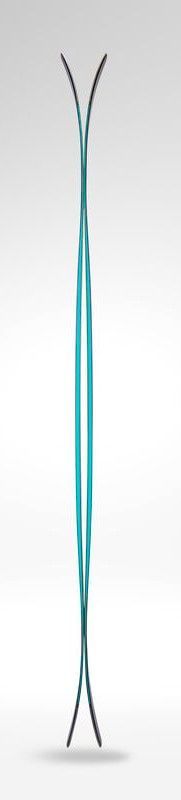
Soul 102
Size tested: 180
(also tested 186- see below for addendum)
Dimensions: 135-102-125
Turning Radius: 17 m
Formerly known as the Sender Soul 102...
Whats the difference? The paint job; Graphic change only.
In some places, the old color scheme was available in a Konect version. Thankfully, that does not seem to be the case for this year.
Significant technologies:
- Poplar PEFC Core
- Titanal Beam
- Rectangular Sidewall
- V-A-S
- Air Tip
- Twin rocker
Last year I said that Rossi 's new lines are clean and good looking. That trend continues for this season, as well. The Soul 102 allows Rossignol to recapture the market for the Soul 7 (hence the name change), while improving it's power and performance such that it's much friendlier for east coast hardpack. The two models are significantly different, with this ski answering the need for a harder charging ski with enough float and more of a directional twin tip feel to keep soft snow skiers happy.
Unlike other vendors, The 102 does not ski such that it loses the ability to carve like its narrower cousins. In fact, the question was raised as to whether or not the 102 is too stiff a ski in its waist width- but the twin rocker addresses that concern handily. This ski lacks nothing in terms of performance, and the preferences of the mid-fat genre skier- it will ski very well for “that guy” who wants to ski a mid-fat ski, every day, in New England.
From a performance perspective, the ski feels like a traditional ski- tighter sweet spot, slightly lower stance, powerful tail, a la traditional Rossignol values. It holds like it’s on rails, powers through the turn, and is both nimble in short turns and stable at speed. I enjoyed the ski very much. It, most certainly, could be skied as an east coast daily driver.
ADDENDUM FOR 2027:
I have since skied this ski in a 186. That length brings this ski back into my mindset as a daily driver. I've always preferred a longer ski, and the 186 skis like I would expect a 182 to 184 to ski (which is appropriate for my size and bearing).
Who should ski this ski?
- Experienced skiers who want a more versatile mid-fat for varied east coast conditions.
- Confident skiers who want the joy of a directional twin that can be driven like a carving ski.
- This ski will ski best with a
stiffer flexing ski boot (115-140 flex)
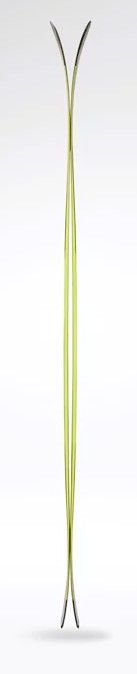
Sender 110
Size tested: 184
Dimensions: 139-109-132
Turning Radius: 16 m
Formerly known as the Sender Free 110...
Whats the difference? The paint job; Graphic change only.
There is no Konect version.
Significant technologies:
- Poplar PEFC Core
- Titanal Beam
- Rectangular Sidewall
- Carbon Alloy Matrix
- V.A.S.
- Air Tip
- Twin rocker
The Sender 110 is everything you'd expect it to be, and not.
This ski is the surprise of a lifetime, and here's why-
First and foremost, if "SENDER 110" wasn't written right on the skis, you'd never know it was a 110 width ski. It holds on darn near anything, flies through powder, and skis through spring crud and corn like skiing through a couple inches of fluff.
I've skied this ski both in the recommended position (otherwise written on the ski as 0 ) and -2. It reminds me, very much, of the (previous generation) Sender 106 Ti + in the 0 position; it's quick, and can be as surfy as you need it. Set your bindings 2 cm back and it feels like a more traditional Sender 104 from the same generation, minus the inflexibility of the full sheets of ti in both skis.
I cannot speak highly enough about how versatile and fun these skis are. Having skied many other wide/powder skis, this is, easily, the best ski in that genre, and quite possibly, crossing into other genres, ever made.
If it were practical to have a 110 as an everyday ski on the east coast (think knees vs. ski width) this would be the perfect single quiver ski.
Ski this ski full length, especially if you mount the bindings at 0.
Who should ski this ski?
- Experienced skiers who want a super versatile wide ski for varied east coast conditions short of glare ice.
- Confident skiers who want the joy of a directional twin that can be driven like a carving ski.
- This ski will ski best with a
stiffer flexing ski boot (115-140 flex)
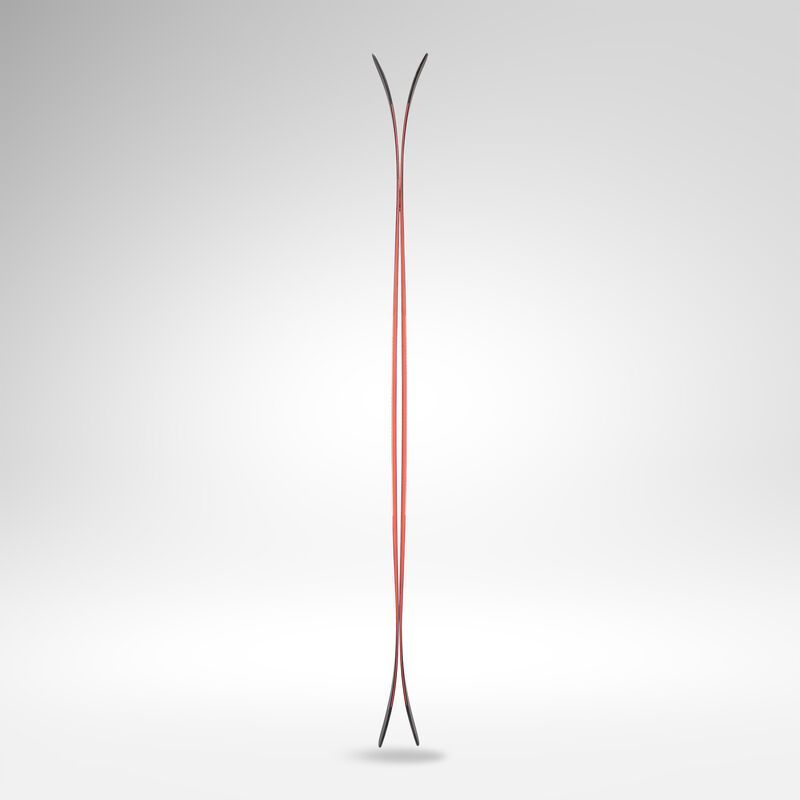
SMOOTH
Salomon....
I was a Salomon boot and binding loyalist since the S727 and the SX 90s. Their bindings remain state of the art, and their boots have come a looooooooong way since the single closure back door and twisty-knob plastic thingamabob that made the boots a little tighter over your instep/forefoot.
The first Salomon ski I ever tried was the first-gen Super Force 9- Traditional sidecut, monocoque construction, foam core... They didn't size them in CM, they just gave them a Power (Pr) rating (which, was based upon some hinky formula that derived the size by extrapolating a skier's height, weight, and level of aggressiveness). I liked the concept, but it didn't catch on. Remember, most people hold a ski up next to them, and if it's over their eyes, they think its too big. THEN, they based the models on an "S" rating for turn size; S1 for GS, S2 for mid-radius, and S3 for slalom. Anyway, that was Salomon being Salomon, and none of it caught on- just like the sizing methodology for their rear entry boots (I was a 345 by the way). That was another concept that had potential, as it included volume in the measurement. That methodology held on a bit longer, until Salomon finally changed their design to a more traditional, two piece, overlap shell (I still have a prototype of that shell, and it was the best boot I ever skied- Thank you Ken!).
That aside, I hated the SF9. It was the exact opposite of my skiing style. It made more of a quick "J" shaped turn, and I preferred a more consistent and round shaped turn. It sounds insignificant, but it's not. I preferred Volkl back then, being a ball of the foot/center of the arch skier.
Without digressing too far, I continued to test them over the years, and never found common ground with them. All the while, owning several generations of Volkl, Rossignol, and Blizzard skis.
Until, this year.
This year they revamped the Stance line; big changes, big happy dance.
They also put some thought into the QST line, which is no longer the dead, wooden-feeling planks they once were.
As for the race line... Well, read below.
Equipe GS 12
Size tested: 175
Dimensions: 115-68-97
Turning Radius: 17 m
Significant technologies:
- Double Ti
- Poplar core with Ash Insert
- 7 degree full ABS 7mm sidewall
- PCS
The day I tested these I decided to spend significant time at the Salomon tent, hoping that I could get on several models of skis I've been dying to try. I had been champing at the bit to test these in particular, for quite a while, and was happy when someone brought them back as I walked up, which allowed me to (basically) grab them on the spot and present them to be adjusted.
I haven't skied a Salomon Race-type ski in several generations of Salomon skis, so I had no idea what to expect.
I'm glad I finally got the chance.
Right off the lift I was thoroughly impressed.
The edge grip was solid, and it was clear these skis are very quiet.
Long story short, I knew I had to be smart about how I apporoached this run, because the skis were too short for me, and that kind of quiet power needs to be respected, especially since this trail is really rolly.
As I progressed down the trail I started to let them open up a bit, increasing speed and turn shape to real GS turns, doing my best to time each turn to avoid being launched off the top of a knoll.
Well, I'm sure y'all could see where this was going right from the start, because I got late on a knoll, and found myself full spread eagle in the air with my ass hanging out over the tail of my skis like Jerry of the Day's wet dream.
By some miracle (and the grace of god) I pulled it together, landed the turn, and finished the run.
My skiing partner for the day said it didn't look that bad, but we all know when we're in trouble, and I was, clearly, in trouble.
Grateful that I had survived scaring myself (and everyone else within 50 yards of me), I took them out for another run, decreasing my turn size a bit. The skis remained smooth and solid, oozing of power; accerating me out of every turn, like a true race ski should.
To sum it up-
These are not some mid to higher end carving skis with racing graphics; these are real race skis.
...and, in a sea of "detuned" race skis, I was pleasesd to have enjoyed a real racer again.
Would I ski them every day? My heart says, "YES!" while my head says, "You might want to rethink that".
Anyway, five stars for these, and at $999.99, they're a steal.
As for you beer league racers-
Sure- but they're not for the faint of heart. There's no "hinky" technology to make them more forgiving or predictable. In other words, you'd better have the skill set, and endurance, to rock these, or they will rock you.
'nuff said. If you can ski 'em, you'll win races. If not.....
Who should ski this ski?
- Racers and former racers. who want a super smooth, and powerful race ski.
- Strong, aggressive, and experienced racers, with well developed skill sets.
- That's it... no flowery this, that, or the other thing. You need to be able to ski a true race ski. That's as plain as I can say it.
- This ski will ski best with a stiffer flexing ski boot (115-150 flex)
- One final point- Pictures don't do these justice, they're downright gorgeous in real lfe.
Addikt Pro 76
Size tested: 175
Dimensions: 125-76-109
Turning Radius: 15 m
Significant technologies:
- Double Ti
- Full Poplar Wood Core
- Full Sandwich Sidewall
- Blade Technology
This ski was a very pleasant surprise.
Firstly, it's really easy to ski on. It's designated as high performance, but it doesn;t have the personality traits of a ski that is difficult to ski on.
I't light, it's quick edge to edge, it finishes a turn very well, and i'ts reasonably stable.
It's targetted for your upright, feet close together, in resort skier.
Anyone can ski it; Riders and Drivers alike- but if your thing is short to medium turns, quick, slashy edge-sets, and/or a high percentage of tail use, these are your skis.
If you're a high edge angle carver, don't over work these; let them move a bit to the outside and then come around naturally... Hard work not required.
The sweet spot on them is pretty darn big, and they respond well to multiple balance points.
Long story short, just go ski them; deep thought not required.
Who should ski this ski?
- intermediate through advanced skiers who want an easy to turn pair of skis.
- Skiers who like to keep their feet close, and make short, quick turns, to medium radius turns.
- Carvers who just want to roll their edges and not work too hard.
- This ski will ski best with a moderate to stiff flexing ski boot (100-120 flex)

SMOOTH
*What's the most common question salespeople get when they sell this ski...?
That's easy, "Why does it cost so much?"
Ok- this is directly from the rep-
(Paraphrasing as I didn't record our conversation)
Stockli is the "last" hand assembled ski. Each step takes one to five days to complete. Each laminate is added by hand, and every step is meticulously performed for quality control. There are no "factory blem" Stocklis- Customers only see the best. Stockli builds about 50,000 skis a year, as opposed to 500,000 like some bigger manufacturers. The wood is also carefully grown in protected forests, and harvested in such a way that it's environmentally friendly and the specifics of the wood are tightly controlled for consistency. Stockli also uses proprietary polymer micro-beads in its glues, which make the skis exceptionally smooth.
So, does all that mean the skis are worth the extra money?
Well, if you want a ski that can ski anywhere, never get nervous, and last longer than many other ski brands, I'd say yes- Most definitely.
...and, as an added bonus, Stockli has so much confidence in their skis, they've upped their warranty to 4 years.
You read that right... FOUR YEARS.
More below...
Montero ar
Size tested: 184
Dimensions: 128-84-114
Turning Radius: 17.3 m
Significant technologies:
- Full Torsion Control
- Adaptive Contact Length
- Polyamid Topsheet
- Mild tip and tail rocker
I've skied this ski in two lengths; the 180 and the 175.
I did that to get a feel for downsizing with this particular ski, as many east coast skiers are reticent to ski a ski at it's proper length.
These are my notes for the 175:
Stable, quiet… very quick edge to edge- a true frontside carver. This is the ski I was able to carry the most speed on while carving, in today’s testing. Be careful, make sure you’re centered on a knoll, or you’ll be cleaning snow out of the back of your shirt and ski pants. Another classic, higher performance, Stöckli. Don’t get back on this ski, or you’ll hook yourself right into the trees.
Many fellow testers compared this ski with the Rossignol Forza, thinking the skis were comparable.
I disagree-
I'll explain why as I continue below.
These are my notes for the 180 (The proper length for my size on the east coast).
I skied the 180 0n a bluebird day, late- so, the snow was firm, with piles of man-made scrape thrown in for good measure.
Having skied this ski once, in the shorter length the year before, I knew it would be stable and consistent. With that in mind, I decided to not hold back, and really push it as hard as possible.
After one run to dial it in, I pointed them downhill and and started rolling them over. It accelerated smoothly, so I added in a touch of counter rotation and drove off the tails to push up the acceleration.
The first thing I noticed was the ski was much more consistent at the correct size. The balance between power and ease of skiing was much more appropriate, inasmuch as the ski gave back exactly what I put into it. The ski was intuitive, smooth, and easy to ski on. That makes it a good ski for a wider variety of skiers- younger skiers will love how hard they can push it, older skiers will love how easy it skis without being scary or hard to handle.
For the next run, I ran it up to speed, rolled it over for short turns, accelerated it back to GS turns, then bounced back and forth in short and long turns with ease. It never threw me, or got nervous, or washed out.
On the next run, I just rolled with the terrain and opened them up as fast as I could make them go. Two runs in and I had 100% confidence in this ski. I powered it forward without any thought to being careful about obstacles, snow conditions, or changes in terrain, and found myself sailing over a knoll, mid turn, and landing like I never left the ground, continuing the run without a worry in the world.
I was about to return the ski when I bumped into a group of co-workers, who suggested we all take a run together. Several in the group just decided to point and go, so I ran the skis flatter and let them build up speed to keep up. There were patches of ice, inconsistent piles of scraped off corn, mashed potatoes... and just about every snow condition that one can expect late in the day, early February in New England. As I was poling my way back to drop off the skis, I marveled at how well these skis skied. My first impression of these skis was a distant memory, at best. In the year since I'd skied them last, The Stockli design team added an "S" shaped cut into the metal in the tip and tail of the skis. This simple change took the buck right out of this horse. This made the ski more fluid, more consistent, and much more fun.
In summary, they are smooth, stable, and surprisingly easy to ski on.
Who should ski this ski?
- Intermediate to advanced skiers who want a super smooth, super versatile ski.
- Strong, experienced skiers, with good balance.
- Experienced skiers who like to ski the whole mountain and prefer a narrower waisted ski. That said, this ski will handle anything you throw at it. It's the perfect single-ski quiver machine for people who prefer an 80 to 86mm waisted ski..
- This is a great ski for the skier who loves medium to long radius turns, with the skill set to turn it short.
- Good all-mountain skiers who ski everything, everywhere.
- Sidenote- Solid intermediate skiers should not be afraid to ski this ski. If your goal is to improve your skillset, this is the ski to do it on, because of its versatility (yes, this is a theme with Stockli skis).
- This ski will ski best with a
Moderate to stiffer flexing ski boot (115-130 flex)
Stormrider 88
Size tested: 184
Dimensions: 128-88-114
Turning Radius: 20.6 m
Significant technologies:
- Titanal Technology (Titec) Pro
- Hand Assembled
- Sandwich Construction
- Mild tip and tail rocker
Last year, I had no great love for this model; it was, for all intents and purposes, a GS racing ski that was 88 underfoot. It had no versatility, and it just wanted (needed) to go fast. That's it, look out traffic, here I come!
This year, Stockli totally revamped this ski, and it was long overdue. This is, by far, the best 88 underfoot ski I've ever had the pleasure of skiing. Mind you, I love the Arcade 88, but the sizing doesn't really work for me, and this ski is significantly more attuned to my skiing style. It's, first and foremost, surprisingly easy to ski. It's versatile and intuitive, holds like one would expect a Stockli to hold, and is genuinely fun to ski.
They handle anything the east coast cann throw at it, be it glare ice of choppy goop, and they handle it without forcing you to adapt your approach for different conditions. Just ski them with confidence- they will handle the rest.
These skis are big smile machines!
I absolutely loved them.
...And they weren't the only surprise in the line this year. I also skied the ar pro and was pleasantly surprised. The biggest difference being, these are what you'd expect in an 88 underfoot carvng ski; they're bullet proof, the turning radius is appropriate and versatile enough for eastern skiing, and they could turn at normal, human speeds. In other words, you didn't have to point them up to 40 MPH just to start rolling them over. They turn, they carve, they handle anything, and they rip!
Who should ski this ski?
- Advanced skiers who want a super smooth, stable, and versatile 88 underfoot, all day ski.
- Strong, experienced skiers, who know how to drive a ski, and want a single quiver, eastern ski.
- This is a great ski for the skier who loves medium to long radius turns, with the skill set to ski a race ski, or to straight-line through anything.
- Good all-mountain skiers who ski everything, everywhere.
- This ski will ski best with a
stiffer flexing ski boot (120-150 flex)
Stormrider 95
Size tested: 184
Dimensions: 132-95-120
Turning Radius: 18.5 m
Significant technologies:
- Full Titanal laminate
- Titec Pro Topsheet
- Full Polywall Sidewall
- Mild tip and tail rocker
This is a BIG smile factor ski.
If you're idea of fun is a ski that can do anything, you've found it.
Last year I skied this in a 188. That’s a lot of ski for east coast skiing, and quite unnecessary, even at my size and strength. The 182 is, clearly, more appropriate for east coast hard pack and crud. Although, I did get a good enough read on this ski to know that for big mountain skiing, the 188 would be a ton-o-fun!
The day I sked the were perfect for testing this ski. I did an extra couple runs on these skis, because I really didn’t want to hand them back in. They were the perfect skis, for the perfect day for testing; messy, clumpy, tracked up New England hard pack trails after 4” of classic New England cement, with large patches of broiler plate in between. The ‘95 tracked effortlessly through everything, made very versatile conversions form short turns, to long, then short again. They held exceptionally well, and quite efficiently, without unnecessary energy expenditure. In fact, they were much easier to ski on than expected, because they were so smooth, and intuitive. They didn’t unnecessarily tax you of energy required to fight the ski. Just let ‘em run and they do all the work for you. In fact, they were so smooth, I took them down a tracked up, fairly steep pitch, in full GS turns trying to make them stutter, and they never did.
In summary, they are smooth, stable, and surprisingly easy to ski on.
Who should ski this ski?
- Upper intermediate to advanced skiers who want a super smooth, super versatile ski.
- Strong, experienced skiers, who know how to finish turns, finesse a smear, and drive the edge of a ski.
- Experienced skiers who like to ski the whole mountain. That said, this ski will still rock as a hardpack ski. It's the perfect single-ski quiver machine.
- This is a great ski for the skier who loves medium to long radius turns, with the skill set to turn it short.
- Good all-mountain skiers who ski everything, everywhere.
- Sidenote- Solid intermediate skiers should not be afraid to ski this ski. If your goal is to improve your skillset, this is the ski to do it on, because of its versatility.
- This ski will ski best with a
stiffer flexing ski boot (120-150 flex)
INTUITIVE

...and she was perfect. She was gorgeous; she was that girl that all your friends would turn their heads to look at and say, “That’s a hot ski”, yet you were not afraid to take her home to mama.
She did all those things you only talked about in whispers… You could ride her hard and fast, you could play with the bumps, you could bounce around in fluff, dance in the park, and you could ski New England hard pack with confidence.
It was versatile enough that you could ski lazy runs with the wife or teach the kids the difference between french fries and pizza In The Barnyard.
She did everything, and she did it well, without complaint.
That Mantra was the perfect ski that came along at the perfect time- especially for people looking to buy-in to the wider ski concept but didn’t live in a soft snow paradise like Utah or Colorado.
She arrived on the scene at a time when east coast skis were still significantly narrower, and meant to be skied a bit longer than head-height.
My skiing style, at the time, was a mildly exaggerated forefoot to heel pressure (a leftover habit from the days of straight skis over 200 cm long), which adored this ski.
After two turns, we were in love, and I no longer needed a quiver full of side-wrestles…
The Mantra became my single quiver ski- all day, every day.
I skied that ski far longer than any ski should’ve been skied. In fact, it still came out to play, just prior to the day I skied the M7; about 12 years- one of the longest relationships I've ever had.
After the great success of that ski, things began to change. There were several permutations of it; more rocker, less rocker, stiffer, more sidecut, less sidecut... eventually evolving away from that original first-generation ski, in attempts to please a changing skier population in a genre of skis that evolved (mutated) faster than a virus.
Most of you are more familiar with the later generation Mantras, like the M5 and the M6- They were gorgeous; you coveted them from afar, you dated them, you loved them, and you even married them… But they were the Betty Draper of the Ski world. You could take them home to mama, they could raise your kids, and they could get the good housekeeping seal of approval, however, alas, one required a side wrestle for true fulfillment, because these M series skis were targeted for a more specific kind of skier; the skier I refer to as "the “Rider”.
In other words, it took a bit more work for traditional “Drivers” to handle this ski at slower speeds. Your "point and go" skiers loved it for it's stability and ability to plow through anything, while your carving skiers learned to just "let 'em run" to keep from tiring themselves out.
Now along comes the M7.
-This is the Ski you divorced Betty Draper for-

Two turns in, and the smile was back on my face. This ski loves to carve turns, without being a “carving” ski… Roll it up on edge, give a light touch to your outer ski big toe and inner ski pinky toe, and she’s your sexy dance partner. Finish the turn with a subtle roll-back to the front of your heel and it finishes a turn like it’s on rails. Conversely, end your turn while sitting centered over your mid arch, and she smears effortlessly and predictably.
You can point it and go anywhere with confidence.
Here’s your M# series ski that both riders and drivers will love; with a big enough sweet spot to appeal to both new schoolers and old schoolers alike. Yet, it’s not dull and boring as many large sweet spot skis are notorious for- This ski is no one trick pony; it’s playful and powerful, it’s stable and quick, and it’s fun and exciting.
Long story short- Ski her hard and fast and she holds-on with stability and grace. Ski her with short and quick turns, then go back-and-forth between long and fast, and then back to short and quick, and she does it all with a smile then asks you to do it again. This ski truly does it all, and does it with fine adjustments, rather than big, tiring motions which shorten your ski day.
...and it's the 4 Radius design that makes it all happen.
Mind you, every ski manufacturer comes up with some marketing term for something they do a little different about their ski. As for Volkl, "4D" really makes sense after you've skied the ski.
Case in point- I was a big proponent of Volkl’s prior generations of 3D sidecut (the predecessor to the 4 Radius), as that really improved edge grip and ski control; adding versatility to a ski genre that was once a one trick pony. Here, with 4 Radius, that design really has mastered all 4 of the turn radii advertised on the tail; R26/R41/R17.9/R23, all with subtle and intuitive changes of stance and pressure.
The 4Radius Sidecut
really makes the difference in slower/tighter turns; Shorter turns are more intuitive, in fact, downright effortless, compared to previous M# series Mantras and other skis of this genre.
I think I will find a way to hang that pretty Mantra of yesteryear on the wall, where she can be appreciated for what she is.... a thing of the past.
Thank you Volkl.
As always, you’ve reaffirmed my faith in you.
As I said to the guys in the Volkl tent at the demo, “When Volkl says they’ve made something better, they really have“.
Mantra M7
Size tested: 184
Dimensions: 139-96-121
Turning Radius: (26 m) (41 m) (17.9 m), (23 m)
Significant technologies:
- Tip and tail rocker
- Carbon tips
- Tailored Titanal Frame
- 4D Sidecut
- Subtle tip and tail rocker
Volkl has made a determined effort to ensure consistency in their skis, no matter what length you ski. The M7 breaks new ground in that effort.
In the past, a ski company would design a ski in a particular size, then make other sizes the same way.
For a particular model, the shorter skis in a model line were typically difficult to flex. Some tried to make the overall thickness of the skis a bit thinner, to make it easier to flex shorter versions, but that comes with inherent issues (as you can imagine).
For that same model in longer sizes, the flex became more manageable, but the turning radius increased as the ski got longer.
In fact, some companies would change their sidecut with different ski sizes, so that skis in different lengths would still turn the advertised turn radius.
Volkl has overcome this with some inventive engineering. Their skis rely both upon sidecut shape, and tailored titanal inserts to manage stiffness and provide Volkl's proprietary “4 Radius” turn shapes in every size. In other words, Volkl can keep flex and turn shape consistent with only subtle differences in the 4R (radius) values as you go from shorter to longer lengths. It’s my feeling that those very subtle differences are irrelevant- the differences are nearly imperceptible.
The relevant point is that each ski length is tuned to perform the same way, and they do.
In terms of construction, Volkl uses carbon tip inserts to effectively filter out unwanted frequencies of vibration in the tip, without adding swing weight.
The Titanal framing is also tailored to work with the multi-layer wood core in such a way that it provides the correct edge grip and power profile for each size.
Long story short, each size performs like its bigger or smaller brother.
That may sound like it’s a no brainer, but it really isn’t. It takes some serious German engineering to pull this off, and Volkl has just about perfected it. Volkl has built on the experience and lessons learned from the evolution of previous M# models, and the M7 skis like the culmination of those efforts.
Personally, I love the versatility of this ski. The thing that really rocked my boat was that this ski is relatively easy to ski, for a ski at this level of performance. Comparing it to the M6, The M7 is a more intuitive ski; Skis of this level can require significant amounts of energy to maneuver in tighter turns, and while making quick direction changes- The M7 followed my thoughts like I was plugged into it. This is a ski I could ski all day, every day, in everything from tight trees at Burke or Jay, to the open super-highways of Stratton or Okemo, and end any day with a smile.
This is, truly a five star ski. I give it a 5 out of 5.
Who should ski this ski?
- Experienced skiers who want a more versatile ski for varied east coast conditions.
- Confident, hard charging, skiers for deeper snow conditions.
- Experienced skiers who prefer to ski one ski all day, every day.
- Experienced skiers who like to play in the trees, or spring bumps
- Skiers who prefer to downsize one size below head height
- This is a great ski for the skier who wants to own one ski that does it all- especially on the east coast.
- This ski will ski best with a
stiffer flexing ski boot (120-150 flex)
For more about my experience with this ski, see my blurb below:
At this point, I have to acknowledge that I wrote this five years ago; when the M7 model was first launched. No matter the age, it's still applicable.
Ode to The Mantra-
There once was a Ski called the Mantra.
She looked like this:
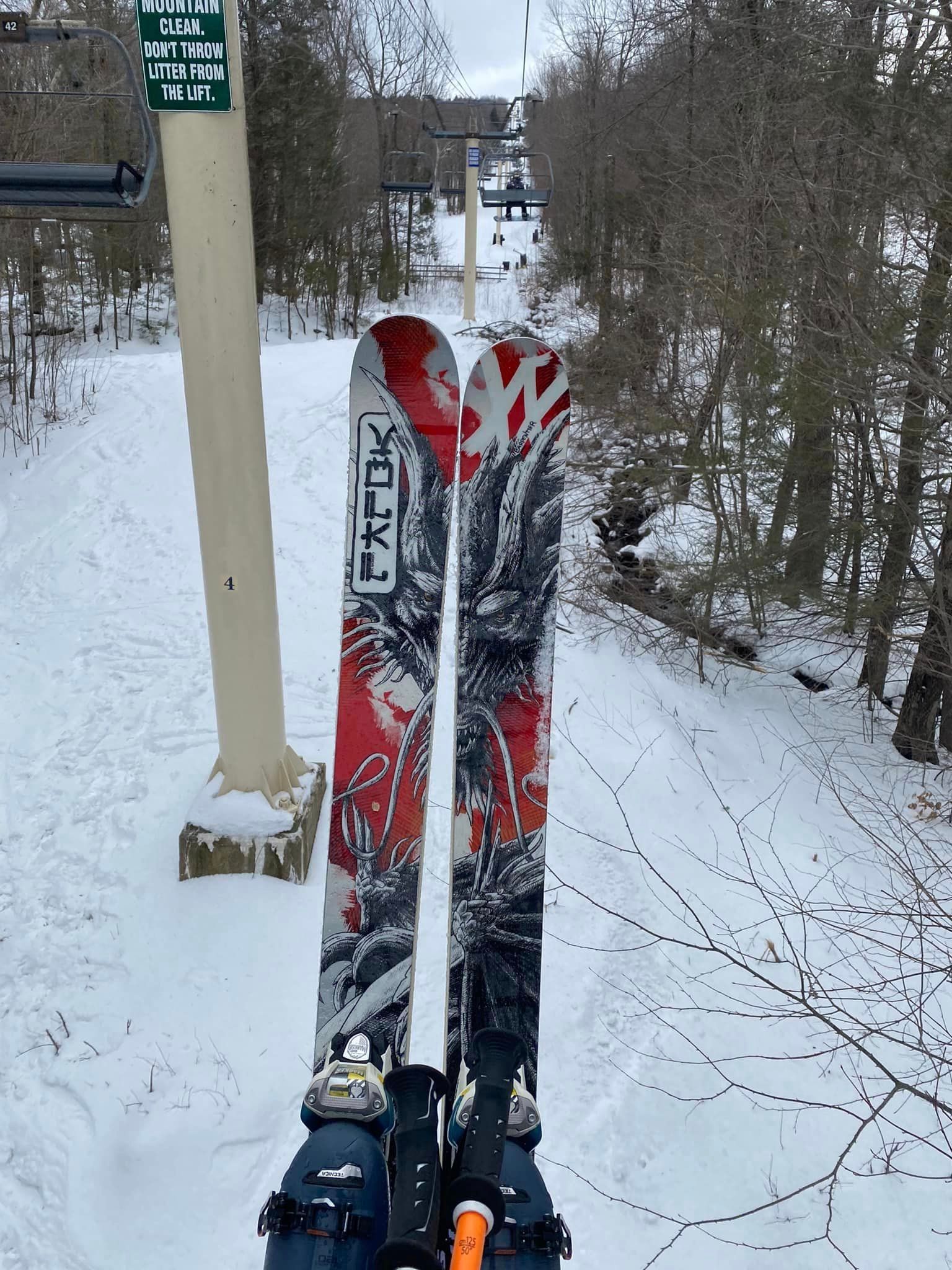

Revolt 96
Size tested: 181
Dimensions: 126-66-117
Turning Radius: (R1) 15.5 m , (R2) 13.4 m, (R3) 14.3 m
Significant technologies:
- Rocker-Camber-Rocker
- Multi-layer Woodcore
- Full Sidewall/Mini Cap
- Full Titanal JUST KIDDING... IT'S A TWIN TIP!
What can I say about these skis, except that they are my guilty pleasure.
I take these out when I want a change of pace, to spend a day in the bumps, or to just do stupid things in the spring.
They're easy to ski, hold up better than most true park skis, and make me look like a better skier than I actually am. On top of that, they love soft snow. Take them out on a floofy day and you will be pleasantly surprised.
I don't give two sh*ts that lighter park skiers don't like them... you do you bud. I like 'em, and I'm gonna ski 'em.
Of course, I ski these full length, I see no reason to ski park skis/twin tips short, unless you're really new at it.
This ski is definitely not something you're going to set a hard edge and drive through a race course, but it does carve a turn pretty well, all things considered (can you tell I'm not a park skier?)
If your thing is that you want to ski a park ski as an all mountain ski, this is one of (maybe) three park-type skis that let you get away with doing that.
Also, as a pipe ski, I think this ski is perfect (yes, I can pop in and out of a pipe from time to time).
Who should ski this ski?
- Average to larger park and pipe skiers who want a ski with a little heft.
- People who want a more traditional twin-tip as a daily driver (even if you don't ski in the park).
- People who realize these look frikkin' cool.
- Put a pivot on them... because, why not? It wont matter, IT'S A PARK SKI FFS!
- This is a great ski for the skier who loves short turns or to point 'em. Don't expect anything in between to be remotely rewarding.
- All-mountain skiers who excel in moguls enjoy this ski. Go ahead and pound through bumps all day long on these- you're less likely to bend it over a carving ski.
- This ski is great in floof, but I'd prefer the Revolt 101 or 114 in deeper snow.
- This ski will ski best with a
soft to moderate flexing ski boot (90-120 flex)
-Although, I ski this with a Cabrio 120 and it's perfect for me. - Lastly, it's a park ski because I say it is. Get over it, don't argue with me (why would you, anyway?)
Revolt 101
Size tested: 182
Dimensions: 133-101-115
Turning Radius: (R1) 24.6 m, (R2) 19.0 m, (R3) 22.4 m
Significant technologies:
- Rocker-Camber-Rocker
- Multi-layer Woodcore
- Full Sidewall/Mini Cap
- Full Titanal JUST KIDDING... IT'S A PARK SKI!
Well, this year's graphic is certainly more exciting than last years... Especially if you like loud and proud. I have to say I prefer last years ivory and black beauties... They were a true testament to chiaroscuro as an art form.
Don't know what that is?
Google is your friend- just don't use Alexa, she's no art afficianado.
So what are these skis, really?
They're newskool all mountain skis that skis well for people who like a park-like ski as they're daily driver. They're not a park ski, but they (kinda) feel like one. The best way to describe them is they ski like a revolt; damp, moderatley soft, and easy to ski on.
Again, you're not going to set a hard edge and drive through a race course, but they do carve a turn pretty well, all things considered.
If your thing is that you want to ski a park ski-feel as a mid-fat, all-mountain ski, this is for you.
Who should ski this ski?
- Anyone who wants a mid-fat ski, with a no-metal, park-ski, feel.
- People who dig "loud and proud" (you know who you are).
- Put a pivot on them, or don't- There's no metal top sheet in these so put anything on them- just try to avoid the really heavy, avante-garde, multi-function rigs that are in vogue this year.
- This is a great ski for the skier who loves to point 'em. They're a "point-n-play" ski, not a carver and not a slalom turner.
- All-mountain skiers who excel in moguls and like a mid-fat enjoy this ski. Go ahead and pound through bumps all day long on these- you're less likely to bend it like you would a carving ski.
- This ski is great in floof and deeper snow.
- This ski will ski best with a
soft to moderate flexing ski boot (100-120 flex)
-Although, I ski this with a Cabrio 120 and it's perfect for me.
-Harken the hyphen!

Racetiger SL
Size tested: 165
Dimensions: 125-67-102
Turning Radius: 12.8 m
Significant technologies:
- Carbon tips
- Full Titanal
- 3D Glass
- Full ABS Sidewall
- Race Plate/Integrated R-Motion 3 GW binding
- Subtle tip rocker
I finallky go to ski The Racetiger SL.
I mention that because it took 5 or 6 different demo days because it was ALWAYS out being skied. I've tried multiple trips, asking the reps to hold it for me, waiting for long periods of time- but at every attempt it was out.
People take this out and they don't return it.
It's that well liked; and for good reason.
When short, exagerrated shape slalom skis first hit the market, they were insanely demanding. You had to, quite literally, crunch your core the entire time you were moving over the snow. The slightest off-kilter twitch would either cause the skis to hook up and drop you like a bad habit, or launch you off the trail right into the trees.
This was part of the reason FIS stepped in to regulate shapes to make them less likely to hurt you.
Since then, manufacturers have moved away from ultra-precse, over-powered death machines to slalom skis that are versatile, consistent, and more stable than any slalom skis, ever before.
Firstly, these are slalom skis and require a traditional, compact, hands forward slalom stance. Yo're not sking an 84mm waist width you can totally relax on. THe stance is quite comfortable for a slalom ski, but it you're an all mountain skidder, better to spend your day on something more forgiving.
RIght off the lift it's easy to see that the edge grip on these was as one would expect from Volkl; solid, sure footed, and trustworthy. You can have every confidence that these will hold on any surface, at any speed, and any shaped turn you can force them to make.
They turn short radius through medium radius shapes, very well. They're relatively easy to ski on, powerful when you need them to be, and overall more confortable underfoot than I would ever have expected from a ski designated "SL".
As a slalom ski they aren't really meant to do long radius turns, but you can set an edge and open up into a pretty wide turn without fear of being launched or bucked. They're really very, very consistent.
I can see why people use these as a daily driver- they're that good.
Who should ski this ski?
- Advanced skiers who want a short turning and powerful carving ski, including (but not limited to) former racers, non-FIS sanctioned racers, and skiers who prefer a powerful quick-turner.
- Strong, experienced skiers, who know how to finish turns, finesse turn shapes, and drive the edge of a ski.
- Experienced skiers who like to ski on groomed snow and hardpack.
- This is a great ski for the skier who loves short turns without being bucked around like a rodeo cowboy.
- Good all-mountain skiers who excel in moguls enjoy this ski, but I wouldn't recommend pounding through bumps all day on this ski, because of the full-length Titanal and more demanding sweet spot.
- This ski will not excel in deep snow.
- This ski will not be friendly to casual mogul and/or tree skiers, especially those who spend more than 20% of their day in those conditions.
- That said, if you are a zipper line bump skier, who likes a faster, stiffer, narrower waisted ski you might be pleasantly surprised by this ski.
- This ski will ski best with a
stiffer flexing ski boot (120-150 flex)

Peregrine 76
(Non-Master)
Size tested: 176
Dimensions: 124-76-104
Turning Radius: 17.6 m
Significant technologies:
- Carbon tips
- Full Titanal
- 3D Glass
- Full ABS Sidewall
- Race Plate/Integrated R-Motion 3 GW binding
- Shortened tip and tail rocker
This ski doesn't resemble the lowride look of the Peregrine 82, or the Deacons. This ski has a traditional sidewall, a more traditional Titanal laminate, and Volkl's ceramic glass to add rebound to the ski.
Yet, standard to Volkl’s skis, the tailored carbon tips remain in the construction of this skill, where they act in concert with the 3D glass to accentuate performance without the ski getting twitchy.
The rocker profile is such that it allows more camber over the length of the ski (for short turn power) without being catchy. The amount of rocker is significantly shorter, giving the ski more effective edge for short turns.
For a ski that has a 17.6m radius designation, it sure feels like a 10-14m radius- That's what more camber and a narrower waist do for you.
Volkl classifies this ski as a Long, medium, and short turning ski, but I can't say I loved this ski for it's long radius turning ability. In short turns, this ski was quick and agile- effortlessly making slalom turns like a true slalom ski, then extending to medium radius turns like one might expect from a short to medium slalom racer. As for long turns, it excels in more of a "J-Turn", which means it makes a quick turn, allows you run it fairly straight for several yards through the transition, then initiates another short, J-shaped turn.
When I went to test my shorter turning skis, I went looking to try The Racetiger SL, since conditions were perfect for it. They didn’t have ANY Racetigers at this demo. So, the rep recommended the Peregrine 72 or 76 as a non-sanctioned/high school club race slalom ski. Given the fact that most of the kids looking for a ski like this want a “one size fits all” ski, I went with the wider width (76).
This ski did not disappoint. It delivers a solid, consistent, and grippy slalom turn which fits the bill perfectly. I found myself quite impressed by its performance. Great ski- I’d put my own kid on it without hesitation.
This ski is, certainly, stiff enough to be skied by skiers who prefer to downsize. However, I do not recommend downsizing more than 1 size from head height. In fact, if you're free-skiing on this ski or using it as a multi-even youth racer, downsizing makes no sense. It turns more than fast enough to handle any slalom course or bump run, so I wouldn't want to sacrifice the effective edge. Long story short, it you're a lightweight skier, you can get away with downsizing and not sacrifice any performance. I am, by no means, lightweight, but I skied this ski much shorter than the 181cm ski I would've preferred, and it held up very well.
This ski is definitely a Driver's ski. Straightlining is not it's forte. .
Who should ski this ski?
- Intermediate to advanced skiers who want a short turning and powerful carving ski, including (but not limited to) former racers, non-FIS sanctioned racers, and skiers who prefer a powerful quick-turner.
- Strong, experienced skiers, who know how to finish turns, finesse a smear, and drive the edge of a ski.
- Experienced skiers who like to ski on groomed snow and hardpack.
- This is a great ski for the skier who loves short turns.
- Good all-mountain skiers who excel in moguls enjoy this ski, but I wouldn't recommend pounding through bumps all day on this ski, because of the full-length Titanal.
- This ski will not excel in deep snow.
- This ski will not be friendly to casual mogul and/or tree skiers, especially those who spend more than 20% of their day in those conditions.
- That said, if you are a zipper line bump skier, who likes a faster, stiffer, narrower waisted ski you'll be pleasantly surprised by this ski.
- This ski will ski best with a
stiffer flexing ski boot (120-140 flex)
As for my specific experience with this ski, I skied it alone, on a steep and firm trail directly under a lift, skiing around the lift towers and occasional hazard sticks to get a feel for it. Again, like the other Volkl skis I'd skied at the demos, the ski turned intuitively. Although, it does prefer a traditional hands forward, lower to the ground, slalom stance.

Peregrine 80
Size tested: 177
Dimensions: 126-80-109
Turning Radius: (27 m) (15 m), (23 m)
Significant technologies:
- Carbon tips
- Tailored Titanal Frame
- Double Wrapped Torsion Box
- 3D Sidecut
- Subtle tip and tail rocker
- Multi-Layer Wood Core
The Peregrine 80 and 82 are n their third year for Volkl, with this years model getting both a color update and a double torsion box construction construction.
What does that do, you may ask? Torsion box construction contribures to torsional stiffness. -Makes sense, right?
Torsion box...
Torsional stiffness?
Anyway, that gives it better edge grip and better response, overall.
Standard to Volkl’s skis, the carbon tips are tailored to effectively filter out the relevant frequencies of vibration that affect stability and edge grip, and provide flex tuning that stiffens the tip, just enough, without adding weight.
The Titanal framing is also tailored to provide the correct edge grip and power profile for each size.
The 3D sidecut adds versatility to the ski, such that it adds stability and edge grip in varied turn shapes and relative speeds.
If you've read my review of the Peregrine 82, you'll think you're reading the same review, there's a reason.
The skis are definitely brothers, cut from the same cloth.
The low ride design makes them both quicker edge-to-edge, requiring less angle to get them to turn. They both store power like no other and return it to you on-demand. Both skis hold a roller coaster flying through a 3G turn.
The difference is in the width, but it's more than just the width.
You may read this and say the turning radius is the same and the dimensions are the same with the exception of the 2mm difference. How can they be THAT different?
...And you'd be right to ask.
So, let me explain-
Those two millimeters, tied to a more slalom-like flex pattern make the Peregrine 80 feel more like a slalom ski. While it's certainly wider than a traditional slalom ski, it's quick and lively turns try to convince you otherwise.
Just touch your pinky toe to your insole and nudge your ankle out a bit, on your inside ski, and press with your big toe and inner ankle on the outside ski, and the difference jumps out at you. The narrower width gives it the versatlity to excel in quicker turns with a livelier feel than the Peregrine 82.
Would this ski excel in a slalom race course?
Probably not.
But it WILL allow you to take a more direct line of attack through a modified NASTAR or beer league race course, and shave seconds off your time.
Not to mention attack the zipper line on any bump run.
As an all around the mountain, east coast gripper and ripper, this ski hammers through bumps, drives effortlessly through crud, and makes ice patches disappear.
This ski is, certainly, stiff enough to be skied by skiers who prefer to downsize. In fact, I skied it in a 177 when my preferred size is a 182. This ski has significant power- but in the shorter length, it dances. It feels and responds with quickness and grace. Its solid edgegrip and consistent power remain intuitive and predictable from one turn to the next. It's not likely to buck you, as the sweet spot is just big enough to make it forgiving such that it keeps
you in the drivers seat, instead of the other way around.
This ski is definitely a Driver's dream ski, like it's chubbier brother. For people who like to drive a ski down the fall line, and ski a narrow line, this ski is your dream ski.
However, Riders probably wont love it, since they prefer wider skis. That said, the sweet spot is big enough that a more upright skier would enjoy its nimbleness without fear of being launched, if they ski it full sized.
This is, truly a five-star ski. I give it a 5 out of 5.
For the skier who wants to own a relatively quick ski that does it all, especially on the east coast, this ski fits the bill. It's fast, it's fun, and it's lively but its intuitively controllable nature make it enjoyable without the demands of a race ski.
Who should ski this ski?
- Experienced skiers who want an exciting and powerful carving ski, including (but not limited to) former racers, non-FIS sanctioned racers, and skiers who prefer a very lively, powerful, and stable ski.
- Strong, experienced skiers, like quick edge changes.
- Experienced skiers who like to ski on groomed snow and hardpack- and prefer a ski that drives through crud rather than floating above it.
- Skiers who prefer to downsize one size below head height.
- This is a great ski for the skier who wants to own one ski for hard pack and groomed snow and likes to move quickly down the fall line- especially on the east coast.
- This ski will not excel in deep snow. However, in anything up to 4-5 inches of east coast wet cement, it will power through with grace.
- This ski will not be friendly to casual mogul and/or tree skiers, especially those who spend more than 10% of their day in those conditions, since one would be over-working it to skid your way through a mogul field.
- That said, if you are a zipper line bump skier, who likes a faster, stiffer ski (there are a lot of us out there), you'll be pleasantly surprised by this ski. It prefers to stay in the fall line, as opposed to winding its way through.
- This ski will ski best with a
stiffer flexing ski boot (120-150 flex)
Peregrine 82
Size tested: 177
Dimensions: 128-82-111
Turning Radius:
(29 m) (16 m), (25 m)
Significant technologies:
- Carbon tips
- Tailored Titanal Frame
- 3D SIdecut
- Subtle tip and tail rocker
- Lowrude Binding System
The Peregrine is into its third year for Volkl, stepping in to replace the Deacon entirely.
This cleans up the line significantly, making their upper level carving skis more uniform. That said, the Peregrine isn’t really a replacement for the Deacons; it’s something very much more.
Standard to Volkl’s skis, the carbon tips are tailored to effectively filter out the relevant frequencies of vibration that affect stability and edge grip, and provide flex tuning that stiffens the tip, just enough, without adding weight.
The Titanal framing is also tailored to provide the correct edge grip and power profile for each size.
The 3D sidecut adds versatility to the ski, such that it adds stability and edge grip in varied turn shapes and relative speeds. My guess is that this ski uses a 3D rather than 4D sidecut because the sweet spot needs to be a bit tighter to maintain it's power profile. Due to it's flatter camber profile, you get power and the ability to smear it as needed, which is something most all-mountain carvers severely lack. While it's design is geared more towards powerful carving, the 3D sidecut gives it all the versatility it needs.
This ski is, certainly, stiff enough to be skied by skiers who prefer to downsize. However, I do not recommend downsizing more than 1 size from head height. This ski has significant power- you will need enough effective edge for grip, and enough length, to maintain balance on its powerful sweet spot.
In short, The Peregrine 82 is no casual skier’s ski.
This ski is definitely a Driver's dream ski. However, Riders wont love it, since they prefer straightlining to carved turns.
This ski would fit very well as a beer league or non-FIS high school race ski for strong skiers. It's also a solid carver for a strong or skilled skier who wants something more exciting- like a Ferrari over a Ford.
It fills a gap left by the detuned racing carvers that were once featured in Volkl's line (circa 2017-ish) that once featured race bindings and the EVO vibration dampener. The exception being that the term "detuned" does not do this ski justice. There's nothing "de" about this ski- It's a finely tuned race car with all the excitement to go along with it, yet it's still fun to drive.
This is, truly a five-star ski. I give it a 5 out of 5. For the skier who wants to own one that does it all, on groomers, especially on the east coast, this ski fits the bill. It's fast, it's fun, and it's lively, yet its intuitively controllable nature make it fun without the demands of a race ski.
Who should ski this ski?
- Experienced skiers who want an exciting and powerful carving ski, including (but not limited to) former racers, non-FIS sanctioned racers, and skiers who prefer a very powerful and stable ski.
- Strong, experienced skiers, who know how to finish turns and drive the edge of a ski.
- Experienced skiers who like to ski on groomed snow and hardpack.
- Skiers who prefer to ski a full length ski or downsize one size below head height
- This is a great ski for the skier who wants to own one ski for hard pack and groomed snow- especially on the east coast.
- This ski will not excel in deep snow, but it will charge through crud.
- This ski will not be friendly to casual mogul and/or tree skiers, especially those who spend more than 10% of their day in those conditions.
- That said, if you are a zipper line bump skier, who likes a faster, stiffer ski (there are a lot of us out there), you'll be pleasantly surprised by this ski.
- This ski will ski best with a
stiffer flexing ski boot (120-150 flex)
For more about my experience with this ski, see my blurb below:
The first year this was introduced I got a chance to ski it at the January Pico demos.
I was ready to call it a day after a long day of testing, and having just come off a bunch of different carving skis. Most of the testers had already called it a day and headed into the lodge when I walked by the Volkl tent and noticed the brightly colored Peregrine. With a bright blue -almost periwinkle- primary part of the color scheme, and then orange highlights (lets not forget the matching bindings), the ski really jumped out at me (it has changed colors twice since then, with it's current iteration black and yellow). It's a gorgeous ski that stands out while on display in a sea of other skis.
Earlier in the day I had a conversation with another tester on the lift, so I stopped to ask the rep about it, as a last minute thought- thinking that I wanted to add this ski to my testing agenda for the next day.
With a similar low-ride construction to the Deacons, there are a few differences which jump out to the experienced eye; the surface of the skis, at the tip and tail, have raised areas which stiffen the ski, and the tip has the addition of the distinct black web pattern of Volkl’s carbon tip technology. This ski has a recognizable lower profile construction, but it it beefier than the Deacons of previous years.
I asked a few questions, then informed the rep that I was heading in. He recommended I try it that day, because, he wanted to emphasize how well the ski would perform in the scraped off conditions of a high traffic ski day, so I relented. He used car analogies to describe this ski; I asked him how he would classify this ski against previous/other models that fit into this genre; "So is this your Mercedes... or is it more like a Porsche...?" His response; “This ski is completely different- It's more of your F1 race car.” - It was clear he wanted to make sure people classified this differently than the previous Deacons in this width, or other carving skis.
He was right- these skis are much better than the Deacons.
The length I typically ski was not available, so I took out the 177, which was the longest size available at that time- one size down is rarely a sticking point when trying most skis, for me.
Five minutes later, I was off the lift and ready to go, not putting much thought into the skis attached to my boots. Lost in thought, reviewing the days events in my mind as I slid off the lift, I glided onto the trail under the lift and started my run. A few turns in, I, quite literally, cried out, “HOLY S#*T!”, as I was merely expecting a mildly “suped up” version of a Deacon (we all fall victim to preconceptions sometimes).
That description, in my mind was... insufficient.
In short, this ski is a rocket ship. It is not the oversized sweet spot, cruising machine, the previous Deacon 84 was, and it should not be compared to that ski. This is a different ski, altogether. It accelerated out of every turn; so smoothly that it took a minute to realize how fast I was going. This ski is powerful, easily held like it was on rails (no more smeary finishes with this ski), and had me effortlessly breaking the speed limit by the 3rd or 4th turn. This ski, most certainly, has roots that come out of the race camp.
This ski brings excitement back to the carving ski genre. The first thought that came into my mind is that a heavy set, out of shape, weekend warrior, ski with the kids, LR4 driving, never buckles his boots after skiing, never in the gym, casual skier, is gonna be in for a big surprise.
...and it's about time.
These skis have an improved sweet spot, bringing back a more traditional power profile, without being difficult to ski- The balance and stance are quite intuitive, as if the ski whispers in your ear to Let 'er rip!
This ski has phenomenal natural power, moving away from the superhighway cruising skis that overtook the carving genre of recent years.
I thoroughly enjoyed this ski- I'm glad the rep suggested that I take it out before I ended my day- it certainly left a good and lasting impression on me, not to mention a "Cheshier Cat grin" on my face to end my day.
In short, my impression is that this is a REAL carving ski, without being a race ski (and/or being bound to the limitations of a race ski). It would seem that this year's demos featured several skis from multiple brands/vendors who decided to move away from the dead, over-sized sweet spot, feather bed, ten-ply, yawn machines of recent years.
If you were one of those people who once thought carving skis were boring, you need to rethink that, and try this ski. The vendors have taken those concerns to heart, and returned the carving ski to it's once and future glory.
V.WERKS 100
Size tested: 179
Dimensions: 124-76-104
Turning Radius:
(R 36) (R17)
(R28)
Price: $2,499.99
Significant technologies:
- Recycled Steel Edges
- Full Titanal
- 3D Milled FSC Wood Core
- Flax Fiber web tips
- Tip and Tail Rocker
Volkl has been making a v.werks version of their higher end models since, at least as far as I can remember, the AC 50 Unlimited.
In a nutshell, the v.werks versions are akin to the standard versions on steroids.
Volkl improves the power and edgegrip of these versions, while using lighter and more cutting edge materials (often, leaning towards more environmentally friendly materials, as well).
For 2025, Volkl has:
Katana v.werks (2025)
Peregrine v.werks (2025)
v.werks 100 (2025)
In terms of previous years inventory, you can find (as of this writing):
Deacon v.werks (2024)
Katana v.werks (2023)
Mantra v.werks (2023)
By far, the most expensive of the lot, is the v.werks 100, as listed on the Volkl website.
"Is the price worth it?", you may ask...
Let's discuss.
Volkl designed this ski with an environmentally conscious mind-set. They use Flax fiber in the tips as opposed to the carbon webbing featured in it's other models.
The wood core is made from FSC certified poplar and beech. For those of you wondering was "FSC" is, it's an organization that promotes responsible forest management and sustainable lumber production, with an eye on local community rights and the protection of other species in the region.
While using a full sheet of Titanal instead of titanal frames in the tip and tail, they use carbon wings to reduce swing weight and give it the torsional rigidity required to give this ski superior edge grip. Lastly, they use P-Tex 4504, which is a high end base material that's harder, and infused with additives to improve glide and wax absorption. High end bases like this are usually found in race skis only.
The v.werks 100 isn't the big brother to another ski in the line; it's like a redesigned version of the Blaze, which is more capable as a single quiver ski.
The ski did everything as advertised; it certainly skis like a “suped-up” version of The Blaze, keeping in mind that it's still a ski that's 100mm width underfoot.
This ski is akin to a Land Rover with the heart of a Porsche- More power, better edge grip (noticeably stiffer torsionally), yet very light. It can certainly double as a resort touring ski- with a pair of Dukes to accommodate both uphill and downhill performance.
Who should ski this ski?
- Intermediate to advanced skiers, who like to "point and go", or want a single ski to double up as a hybrid touring rig.
- Experienced skiers who like to ski on soft snow and groomed trails.
- Experienced skiers who ski with enough finesses to handle carved and smeared turns from one turn to the next.
- This ski is truly unique to the line. While I compare it to a Blaze, it's not a blaze... That's just what it most closely resembles in terms of who should ski it. The difference is, this ski is made for "higher end" skiers, both in terms of ability and ability to afford such a ski.
This ski will ski best with a
stiffer flexing ski boot (120-140 flex).
As for my specific experience with this ski, I skied it alone, on a steep and firm trail directly under a lift, just like the Peregrine 76. I wouldn't normally have skied this ski, but the rep, who I've known for many years, offered it to me while I waited for another ski to be returned.
That said, I appreciate his trust.
This is NOT the ski to go diving into the woods with, and return it to the tent with core shots in it.
Needless to say, I was cognizant of where I skied with it, and only skied it for two runs.
It skied very well, noting that it's obviously a 100mm ski underfoot, as the edge grip is a bit more smeary than a 76, or even an 82 mm ski on ice coast snow. That's as it should be, of course, given it's design.
After that, I took it on a different trail with a little scrapy slough built up on the sides, and it skied great. It prefers to be a hard charger as opposed to a pure Driver's ski, but it will carve just fine. However, you will feel like you had a workout after a couple runs of trying to carve short to medium radius turns with it on hard pack. This ski wants to run, and is stable enough to handle being pushed way beyond the speed limit.
In the end, it really was a nice ski. From a personal perspective, I guess my blue collar roots just can't fathom spending that much money for a ski, then having an aneurism for needing a base fill after hitting some snow snake buried under the surface cover.
END 2027 SKI REVIEW
2024-25 skis and boots
I attend several ski demos over the course of a year. At these demos, ski industry people are able to test new skis, boots, bindings, and accessories before they are released to the public, and after most final design changes have been made. My mission is to test skis with the goal of understanding who would enjoy each product the most, what the differences are from previous versions/models, and to help describe each product with as little jargon as possible. These reviews are for you; the skier, to help understand what a ski does and who it is best suited to. I try and make each review as easy to understand as possible, while describing how the marketing terminology applies towards the performance of the ski (I make the techno-language understandable as best I can). Along the way, you may find some interesting anecdotes around my personal experiences at that demo, or while testing some products, as a sense of me offering an insight to what really goes on at these events.
A few key points:
- There aren’t bad skis, but there are skis which are bad for some people- and that goes beyond putting a beginning skier on an FIS race ski, or a racer on a rental ski.
- Like it or not, skiing is absorbing the antidisestablishmentarianism once embraced by snowboarders. The outdoor industry is seeing a steady trend where the number of snowboarders are decreasing, and skiers increasing (at a much faster rate, by the way). The improvement in technology and ski offerings lured people (young and old alike) back to skiing, and has produced a generation of “Riders” that traditionalists have a hard time with. This is a tantalizing subject, so you're sure to see more about this below, in my blog page, and in my glossary.
- It's my intent to test as broad of a range of skis as possible, but sometimes, skis just aren't available for testing.
ABSTRACT:
2024-25 ushers in another step forward in ski design and technology across manufacturers. Ski companies are improving the versatility of their skis across genres, with new models reducing the need to have multiple skis for multiple conditions. Mind you, those models still exist, and for good reason. However, for New England skiers looking to use one ski, all-day, every day, many of this years additions fill that role.
This year you can find models and widths that accommodate diverse style preferences, yet hold up extremely well in the variability that skiing on the east coast provides; mid-fat and wider skis with exceptional power and hold on hard pack, directional twin-tips that carve yet still dance in soft snow, and once boring carvers that deliver exhilarating G-forces without the exacting demands of a race ski.
SKIS
VERSATILE

Maverick 95 Ti
Size tested: 188
Dimensions: 130.5-85-114.5
Turning Radius: 20.8 m
Significant technologies:
- Tip and tail rocker
- Poplar Core
- Titanal Layer
- Dura-Cap Sidewall
If you read the description of this ski on the Atomic website, there's nothing extraordinary about it- This ski has classic construction made with classic materials- Not a lot of hype, not a lot of fanfare.
The Maverick is understated- with a classic look.
With that, that's where "understated" stops.
This ski has been quite popular in The Atomic line of all-mountain skis- for good reason.
Firstly, I skied this ski a bit long for the east coast; most skis in a 188cm length take significantly more work to turn in short to medium radius arcs, on hard pack.
In this case, the 188 was nowhere near as difficult as many other all-mountain skis.
The first thing that jumped out at me was that this ski is quiet and consistent. It skied very well in short, medium, and long radius turns, giving back exactly what you put into it. The power profile is such that it doesn't over-power you; the sweet spot is big, but not so big that the ski is dead. However, it's big enough that it doesn't throw you or make the ride difficult. It's easy to ski on, versatile in all shaped turns, stable at speed, and easily liked by riders and drivers alike.
My single-phrase description for this ski was "Jack of all trades"-
It's not too stiff, nor is it too soft, it's not difficult to ski, and it's fun.
This is the perfect ski for an intermediate through advanced skier, looking for a comfortable ride that isn't over-burdening- It's a great ski for the skier who works hard all week long, then doesn't want to work too hard to ski weekends, and ski the whole day, both days.
Additionally, a lighter weight skier can ski on this, as an advanced ski, and not be overpowered by it.
In a standard length, this ski is perfect. In addition, it's beefy enough to be skied one size down, where it will still hold an edge yet be more nimble in short to medium radius turns.
This ski is a workhorse- solid and consistent, ready to be skied hard for long time and continue to shine.
Who should ski this ski?
- Experienced skiers who want a consistent and versatile ski has plenty of stability at speed, yet turns easily enough in short turns.
- Confident, hard charging, skiers who want a ski in a comfortable stance on a balance point.
- Experienced skiers who prefer to ski one ski all day, every day.
- Skiers who want size flexibility such that they prefer a size longer than recommended, down to a size shorter.
- This is a great ski for the skier who wants to own one ski that does it all- especially on the east coast.
- This ski will ski best with a
moderately
stiffer flexing ski boots (115-140 flex)
Maverick 105 CTi
Size tested: 185
Dimensions: 134.5-104.5-123.5
Turning Radius: 19 m
Significant technologies:
- All Mountain Rocker
- Ash and Poplar Core
- Directional Shape
- CTI Carbon and Titanal
- Dura-Cap Sidewall
The 105CTI is similar to it's little brother, the 95Ti.
In terms of it's construction, the 105 adds carbon to the core, which makes it a bit damper for stability at speed, and a touch "dancier" than skis with Ti alone.
I skied this ski on a day with varied conditions; scrapy hardpack and sloppy mashed potatoes. The 105 handled it like a charm- consistent and versatile, solid underfoot, with a comfortable balance point. It excel when charging hard, powering through muck like it wasn't there.
In terms of overall Power profile, being that it's a mid-fat, the extra surface area gives it a bit more stored energy in longer radius turns. Given that the sweet spot is comparatively large, it still wont over-power you; yet it gives what it gets, increasing the response the harder you push it.
At speed, it's damp, stable, and fun- easily liked by riders and drivers alike.
This is the perfect ski for an intermediate through advanced skier, looking for a comfortable ride on a more traditional feeling mid-fat.
In a standard length, this ski is perfect. In addition, it's beefy enough to be skied one size down, where it will still hold an edge yet be more nimble in short to medium radius turns.
Who should ski this ski?
- Experienced skiers who want a solid mid-fat with plenty of stability at speed.
- Confident, hard charging, skiers who want a ski in a comfortable stance on an easy balance point.
- Experienced skiers who prefer a mid-fat for every day skiing.
- Skiers who want size flexibility such that they prefer a size down or a standard size.
- This is a great ski for the skier who wants to own one ski that powers it's way through everything on the east coast.
- This ski will ski best with
stiffer flexing ski boots (120-140 flex)
Bent 100
Size tested: 186
Dimensions: 129-100-120
Turning Radius: 19.5 m
Significant technologies:
- Powder Rocker
- HRZN 3D Bent
- Directional Shape
- CTI Carbon and Titanal
- Dura-Cap Sidewall
I want to start this evaluation by talking a bit about the Dura-Cap sidewall.
There's nothing new about this construction, where cap technology sits on top of a traditional sidewall.
What IS new is how it's employed. Previous iterations of this technology were applied to carving and race skis- skis made for hardpack. However, the Bent is the brainchild of a collaboration between Atomic and Chris Benchetler, renowned big mountain free-skier.
The dual-technology of the Dura-Cap construction isn't just a marriage of two technologies, it creates something better. This construction functions, when engineered properly, in such a way that skis made this way are exceptionally damp and quiet feeling. That, in and of itself, provides for a more stable ski. Fringe benefits include a unique power profile such that it accommodates multiple styles of skiing effortlessly- In other words, Riders and Drivers both love this ski. When you put this ski on edge, then add power through the turn, this ski responds consistently and powerfully. When ridden flatter, with a more upright stance, the ski smears effortlessly and remains quiet and predictable.
Another feature of the construction of this ski is that it's lighter with a thinner profile. that allows it to flex easily and consistently.
That fact alone makes the ski a good fit for aggressive skiers who like to "play".
The ski switches, and butters effortlessly, yet it's no noodle, even for a big guy like me.
In terms of more about my personal experience with this ski, skiing it in a 185 was unnecessary. I could, very well, have skied it in a 179 and had a great experience. That said, it skied as advertised (and described above). Standing a bit more upright and straightlining down the hill, it quickly reached speeds most skis would have been uncomfortable with.
Dropping into a more athletic stance, then tilting them up on edge with a little bit of counter-rotation in the hip, changed the personality of these skis entirely. They held like they were on rails, and responded powerfully, yet remained quiet and predictable.
I skied this ski on a very cold and hardpacked day. That allowed me to push it hard. In doing so, I found that while this ski was designed as a Freeskiers dream, it rocks on the east coast. That explains it's overwhelming and long lived popularity with a variety of skier ages and types.
In terms of overall Power profile, being that it's a mid-fat, the extra surface area gives it a bit more stored energy in longer radius turns. Given that the sweet spot is comparatively large, it still wont over-power you; yet it gives what it gets, increasing the response the harder you push it.
At speed, it's damp, stable, and fun- easily liked by riders and drivers alike.
The Bent 100 also sports Chris Benchetler's personal graphic design, which appeals to just about everyone. It looks good, and skis good. I guess that makes it an overall great ski (good + good = great, doesn't it?).
This ski appeals to everyone; Kids, adults, lower intermediates, super-advanced skiers, rider, drivers parents, kids, free skiers, casual skier... even people looking to play in the park.
In a standard length, this ski is very good, although, initially, it doesn't feel like it rolls over in carved turns very quickly, until you get a handle on the dual-personality construction. Once you figure that out, it skis great.
Who should ski this ski?
- Various types of skiers who want a solid mid-fat with plenty of stability at speed.
- Confident, hard charging, skiers who want a ski in a comfortable stance and an easy balance point.
- Experienced skiers who prefer a versatile mid-fat for every day skiing.
- Skiers who want size flexibility such that they prefer a size down or a standard size.
- This is a great ski for the skier who wants to own one ski that powers it's way through everything on the east coast.
- This ski will ski best with
moderate to stiffer flexing ski boots (110-140 flex), as long as they are stiff laterally- That's why you can find skiers on this in everything from a Full-Tilt to a full-on race boot.
Montero ar
Size tested: 184
Dimensions: 128-84-114
Turning Radius: 17.3 m
Significant technologies:
- Full Torsion Control
- Adaptive Contact Length
- Polyamid Topsheet
- Mild tip and tail rocker
I've skied this ski in two lengths; the 180 and the 175.
I did that to get a feel for downsizing with this particular ski, as many east coast skiers are reticent to ski a ski at it's proper length.
These are my notes for the 175:
Stable, quiet… very quick edge to edge- a true frontside carver. This is the ski I was able to carry the most speed on while carving, in today’s testing. Be careful, make sure you’re centered on a knoll, or you’ll be cleaning snow out of the back of your shirt and ski pants. Another classic, higher performance, Stöckli. Don’t get back on this ski, or you’ll hook yourself right into the trees.
Many fellow testers compared this ski with the Rossignol Forza, thinking the skis were comparable.
I disagree-
I'll explain why as I continue below.
These are my notes for the 180 (The proper length for my size on the east coast).
I skied the 180 0n a bluebird day, late- so, the snow was firm, with piles of man-made scrape thrown in for good measure.
Having skied this ski once, in the shorter length the year before, I knew it would be stable and consistent. With that in mind, I decided to not hold back, and really push it as hard as possible.
After one run to dial it in, I pointed them downhill and and started rolling them over. It accelerated smoothly, so I added in a touch of counter rotation and drove off the tails to push up the acceleration.
The first thing I noticed was the ski was much more consistent at the correct size. The balance between power and ease of skiing was much more appropriate, inasmuch as the ski gave back exactly what I put into it. The ski was intuitive, smooth, and easy to ski on. That makes it a good ski for a wider variety of skiers- younger skiers will love how hard they can push it, older skiers will love how easy it skis without being scary or hard to handle.
For the next run, I ran it up to speed, rolled it over for short turns, accelerated it back to GS turns, then bounced back and forth in short and long turns with ease. It never threw me, or got nervous, or washed out.
On the next run, I just rolled with the terrain and opened them up as fast as I could make them go. Two runs in and I had 100% confidence in this ski. I powered it forward without any thought to being careful about obstacles, snow conditions, or changes in terrain, and found myself sailing over a knoll, mid turn, and landing like I never left the ground, continuing the run without a worry in the world.
I was about to return the ski when I bumped into a group of co-workers, who suggested we all take a run together. Several in the group just decided to point and go, so I ran the skis flatter and let them build up speed to keep up. There were patches of ice, inconsistent piles of scraped off corn, mashed potatoes... and just about every snow condition that one can expect late in the day, early February in New England. As I was poling my way back to drop off the skis, I marveled at how well these skis skied. My first impression of these skis was a distant memory, at best. In the year since I'd skied them last, The Stockli design team added an "S" shaped cut into the metal in the tip and tail of the skis. This simple change took the buck right out of this horse. This made the ski more fluid, more consistent, and much more fun.
In summary, they are smooth, stable, and surprisingly easy to ski on.
Who should ski this ski?
- Intermediate to advanced skiers who want a super smooth, super versatile ski.
- Strong, experienced skiers, with good balance.
- Experienced skiers who like to ski the whole mountain and prefer a narrower waisted ski. That said, this ski will handle anything you throw at it. It's the perfect single-ski quiver machine for people who prefer an 80 to 86mm waisted ski..
- This is a great ski for the skier who loves medium to long radius turns, with the skill set to turn it short.
- Good all-mountain skiers who ski everything, everywhere.
- Sidenote- Solid intermediate skiers should not be afraid to ski this ski. If your goal is to improve your skillset, this is the ski to do it on, because of its versatility (yes, this is a theme with Stockli skis).
- This ski will ski best with a
Moderate to stiffer flexing ski boot (110-130 flex)